
Unblocking AI Bottlenecks & Scaling Code Orchestration in 2026

As organizations scale autonomous coding agents, the primary engineering challenge shifts from generating code to managing integration bottlenecks. Mastering Agentic Software Engineering requires solving context boundary limits, eliminating pull request review fatigue, and establishing automated architectural gatekeeping across multi-agent systems.
Table of Contents
- The New Engineering Bottleneck in 2026
- 3 Critical Bottlenecks in Agentic Software Engineering
- Visualizing the Agentic Code Orchestration Cycle
- Strategic Architecture: Moving from Writing to Orchestrating
- Frequently Asked Questions
- Conclusion & Next Steps
- Sources & Image Attributions
The New Engineering Bottleneck in 2026
The widespread adoption of generative coding models has solved the syntax generation problem. Developers can scaffold features and generate entire service layers in seconds. However, this explosion of raw code output has exposed a new set of organizational hurdles: reviewing, verifying, and integrating agent-generated code at scale.
In modern Agentic Software Engineering, the developer's role has shifted from writing lines of code to orchestrating intelligent agents. To maintain architectural integrity, engineering teams must build robust feedback mechanisms and automated verification pipelines.
Combining structured engineering discipline with principles from Clean Architecture and personal productivity workflows like Apply the 80-20 Principle for Productivity ensures teams scale output without accumulating massive technical debt.
3 Critical Bottlenecks in Agentic Software Engineering
Scaling autonomous agents across enterprise repositories introduces three primary friction points:
1. Context Fragmentation & Architectural Drift
When agents operate on localized files without understanding full system architecture, they risk introducing inconsistent state management patterns or duplicating existing utility libraries.
2. Senior Maintainer Review Fatigue
As junior developers and agents submit dozens of pull requests daily, human maintainers become overwhelmed by the volume of diffs requiring review.
3. Cross-Agent Integration Failures
Multiple agents working on isolated microservices can write syntactically flawless code that fails upon end-to-end integration due to subtle contract mismatches.

Visualizing the Agentic Code Orchestration Cycle
Overcoming these bottlenecks requires a structured orchestration loop that validates changes automatically:
flowchart TD
    A["Lead Architect Defines Domain RFC & Schemas"] --> B["Central Orchestration Engine"]
    B --> C["Sub-Agent 1 (Domain Logic)"]
    B --> D["Sub-Agent 2 (Presentation & API)"]
    C --> E["Automated Contract & Integration Testing"]
    D --> E
    E -->|Contract Mismatch| B
    E -->|All Tests Pass| F["Automated AI Security & Style Audit"]
F --> G["Staff Architect Final Review & Merge"]Always define immutable OpenAPI or GraphQL schemas before dispatching coding agents. When frontend and backend agents code against shared, strictly typed contracts, cross-service integration errors drop by over 80%.
Strategic Architecture: Moving from Writing to Orchestrating
To thrive in this new development paradigm, engineering teams must implement three core practices:
- Shift Upward to Architecture: Focus engineering bandwidth on domain boundaries, database relationships, and failure recovery strategies rather than repetitive implementation details.
- Automate Quality Gating: Deploy comprehensive test suites and automated reviewers—like Automated AI Code Review—to catch regressions before human review.
- Maintain Structured Career Logs: Track architectural wins and debugging solutions systematically using an Engineering Work Logs System to ensure organizational learnings compound.
Frequently Asked Questions
What is Agentic Software Engineering?
Agentic Software Engineering is the discipline of orchestrating multiple autonomous AI agents to design, implement, test, and deploy software systems based on high-level technical specifications.
How do teams prevent AI code review fatigue?
By enforcing strict automated CI/CD gates (static analysis, type checkers, unit tests, and security scans) that reject failing code before a human engineer ever opens the pull request.
What is the most important skill for developers in the agentic era?
System architecture and specification design. Knowing how to define clean domain models, API contracts, and edge-case requirements is far more valuable than memorizing syntax.
Conclusion & Next Steps
The shift toward Agentic Software Engineering represents a permanent evolution in how digital products are built. By resolving organizational bottlenecks and mastering multi-agent orchestration, engineering teams deliver software at unprecedented velocity and scale.
At Masri Systems, we architect high-performance digital platforms and modern software backends. Explore our specialized Software Development and Website Architecture services to see how we build resilient digital infrastructure for modern enterprises.
Sources & Image Attributions
- Header Image: Developer working on code review by Caspar Camille Rubin on Unsplash
- Body Image: Engineers collaborating on software architecture by Annie Spratt on Unsplash
Follow Masri Systems on Google
Add us as a preferred source in Google Search.
Related Articles & Guides
AI Agent Workflow Automation: Curated 123-Tool Stack
Curated directory of 123 open-source AI agent frameworks, MCP servers, and developer tools for production AI agent workflow automation and autonomous systems.
Free Developer Certifications: 5 High-Impact Courses & Badges
5 verifiable free developer certifications and coding courses from Postman, Google Cloud, DeepLearning.AI, and freeCodeCamp to elevate your engineering resume.
Geschäftsprozesse automatisieren: 17 Scheduled Tasks der Agentur
Wie Masri Systems 17 autonome Agenten-Jobs, Sidecars und Cron-Tasks einsetzt, um Geschäftsprozesse im Entwickler-Alltag wartungsfrei zu automatisieren.
Command Center: Autonome KI Agenten Geschäftsprozesse KMU steuern
Autonome KI Agenten Geschäftsprozesse KMU: Steuern Sie Gemini, Codex und Claude parallel in einem sicheren VILT Stack Command Center mit OS-Locking.

Sectors of Computer Science & Software Engineering
Explore the primary disciplines of computer science, tech career paths, software engineering specialization tracks, and modern developer tooling.
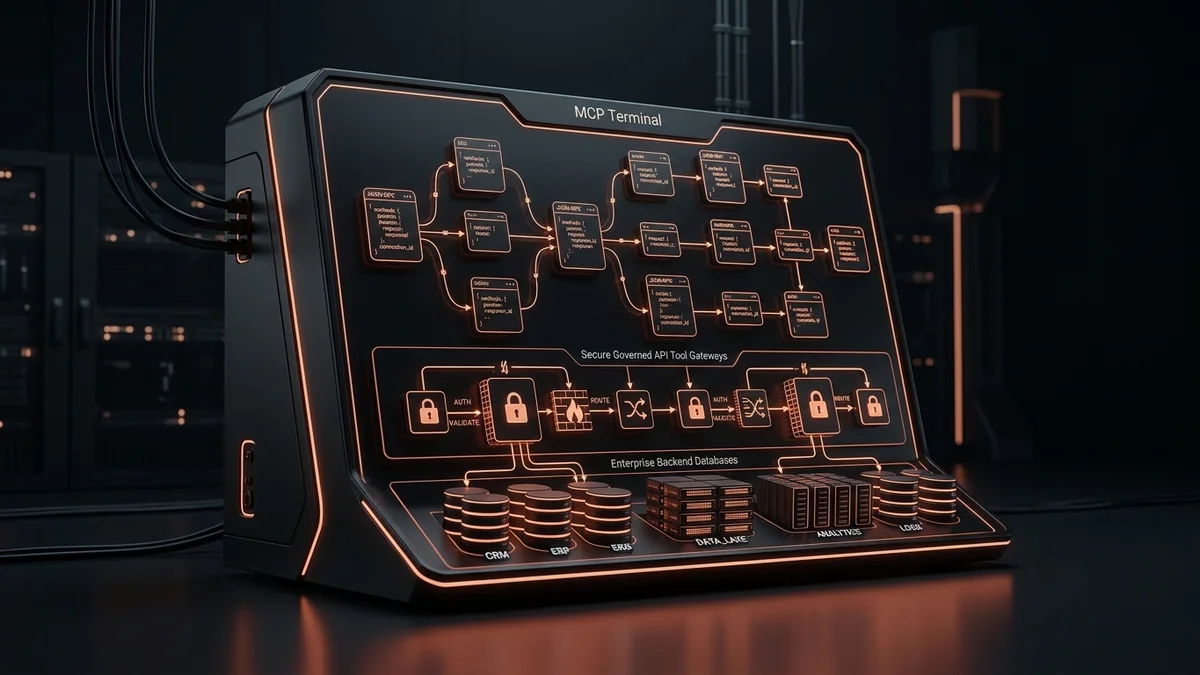
Custom MCP Server Development: Give AI Agents Real Business Access
Custom MCP Server Development connects Claude, ChatGPT, and Gemini to your actual business systems — securely, without duct-taped API hacks.

Portable AI Agent Skills: One Skill, Every Model
Stop rewriting the same AI agent workflow for Claude, Gemini, and Codex. Build portable skills once with AI Agent Workflow Automation and sync everywhere.

Software Engineer Career Roadmap
Explore the complete software engineer career roadmap. Master junior to senior transitions, high-demand tech specializations, and modern AI development.