
Applying the 80/20 Rule to Software Engineering

Software development often suffers from task fragmentation and notification bloat. Applying targeted developer productivity hacks through the 80/20 Pareto principle enables engineers to isolate the 20% of architectural tasks that produce 80% of project momentum, reducing burnout while delivering robust, scalable software.
Table of Contents
- The Pareto Distribution in Modern Engineering
- 4 Core Developer Productivity Hacks Using the 80/20 Rule
- Visualizing the Engineering Impact Funnel
- Managing Context Switching and Focus Blocks
- Frequently Asked Questions
- Conclusion & Next Steps
- Sources & Image Attributions
The Pareto Distribution in Modern Engineering
Software engineers routinely start their day with a massive backlog of tickets, pull requests, and Slack pings. By evening, after attending multiple status calls and context switching across repositories, the core business features remain untouched.
This friction arises from treating all development tasks with equal priority. The Pareto principle—originally documented by Vilfredo Pareto—states that roughly 80% of outcomes originate from 20% of causes. In technical projects, this means that 20% of your codebase, architecture decisions, and core workflows generate 80% of your application's business value.
Implementing tactical developer productivity hacks centers on identifying and ruthlessly protecting this 20% core. When you prioritize high-leverage architectural patterns like Clean Architecture, you spend less time firefighting downstream regressions and more time shipping critical features.
4 Core Developer Productivity Hacks Using the 80/20 Rule
Here is how high-performing software teams apply Pareto mechanics to their daily workflow:
1. Isolate High-Impact Architectural Features First
Every sprint contains essential business logic and peripheral polish. Identify the two most critical tickets that directly unblock team members or deliver user value. Commit your highest energy morning hours to these core components before opening communication channels.
2. Time-Box Code Reviews and Communication Windows
Asynchronous communication frequently degrades into constant interruptions. Rather than checking pull requests reactively throughout the day, batch reviews into two dedicated 30-minute intervals (e.g., 11:30 AM and 4:30 PM). This preserves extended deep-work state for complex system design.
3. Automate the 80% of Repetitive Boilerplate
Routine scaffolding, linting, and deployment tasks consume disproportionate mental bandwidth. Invest time upfront into standardized CI/CD pipelines, reusable templates, and CLI shortcuts. Automating routine tasks frees up cognitive resources for difficult algorithmic and data-modeling challenges.
4. Maintain a Living Career and Engineering Work Log
Engineers frequently forget the architectural hurdles they resolved months earlier. Keeping a structured tracking system—such as an Engineering Work Logs System—ensures your technical solutions compound over time and streamline future debugging sessions.

Visualizing the Engineering Impact Funnel
Targeting high-leverage engineering inputs transforms how development bandwidth converts into measurable software quality:
flowchart TD
    A["Raw Engineering Backlog (100% Tasks)"] --> B{"Apply 80/20 Impact Filter"}
    B -->|Trivial 80%| C["Automate / Delegate / Batch (CI/CD, PRs, Status Checks)"]
    B -->|Vital 20%| D["Deep Work Focus (Core Architecture & High-Value Logic)"]
D --> E["80% of Measurable Software & Business Impact Delivered"]Never open your IDE without selecting the single technical milestone that defines today's success. Complete this core component before addressing secondary backlog items or unblocking non-critical tickets.
Managing Context Switching and Focus Blocks
Cognitive switching costs represent the single largest hidden tax on engineering velocity. When a developer gets interrupted during deep logic construction, regaining mental context takes an average of 15 to 23 minutes.
To protect engineering focus, structure your calendar into uninterrupted 90-minute focus blocks aligned with natural ultradian rhythms. Combine this with structured knowledge hubs like OmniVault AI The Developers Second Brain to offload ephemeral details and keep your immediate working memory clear.
Frequently Asked Questions
How do I identify the top 20% tasks in a complex codebase?
Evaluate tasks by their downstream leverage: ask which change unblocks other developers, resolves the root cause of multiple bugs, or directly impacts user conversion. Core data models and API contracts almost always form the high-impact 20%.
Can junior developers apply 80/20 productivity hacks without pushback?
Yes. Communicate your priorities proactively during daily standups. Framing your focus around completing the primary feature before tackling secondary maintenance demonstrates business maturity and strong time management.
How does the 80/20 rule affect code quality and technical debt?
Focusing on the vital 20% does not mean cutting corners. It means applying maximum rigor and test coverage to foundational architecture and hot paths, while avoiding over-engineering peripheral features that rarely change.
Conclusion & Next Steps
High developer velocity is not about typing faster or working 60-hour weeks—it is about directing focused engineering energy where it generates maximum leverage. By incorporating these developer productivity hacks, you protect your focus and deliver cleaner, more resilient systems.
At Masri Systems, we specialize in architecting high-performance digital platforms and streamlined automation workflows. Explore our custom Software Development and Website Design solutions to see how we build scalable digital infrastructure for modern enterprises.
Sources & Image Attributions
- Header Image: Developer planning calendar and workflow by Alvaro Reyes on Unsplash
- Body Image: Clean desk workspace with laptop by Andrew Neel on Unsplash
Follow Masri Systems on Google
Add us as a preferred source in Google Search.
Related Articles & Guides

Free Developer Certifications: 5 High-Impact Courses & Badges
5 verifiable free developer certifications and coding courses from Postman, Google Cloud, DeepLearning.AI, and freeCodeCamp to elevate your engineering resume.

Sectors of Computer Science & Software Engineering
Explore the primary disciplines of computer science, tech career paths, software engineering specialization tracks, and modern developer tooling.

Software Engineer Career Roadmap
Explore the complete software engineer career roadmap. Master junior to senior transitions, high-demand tech specializations, and modern AI development.

Why PHP 8.4 & Laravel Are the Smartest Choice for Web Apps
Explore modern PHP web development. Discover why PHP 8.4 performance, strict typing, JIT compilation, and Laravel make PHP the top choice for software teams.
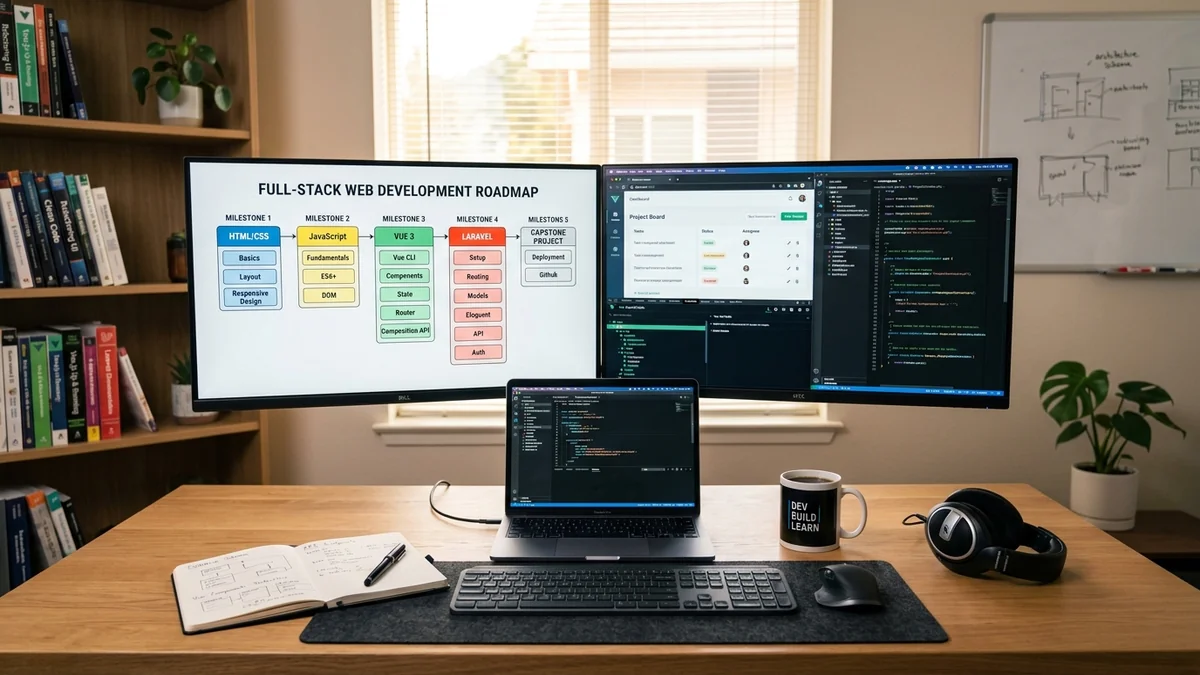
Web Development Curriculum: Full
Master full-stack web development. Comprehensive curriculum covering HTML/CSS/Tailwind, ES6+ JavaScript, Vue 3 & Vite, Laravel APIs, and CI/CD deployment.

Was ist eine Homepage Erklärung
Was ist eine Homepage Erklärung: Erfahren Sie den entscheidenden Unterschied zur Website, die 3 Kernaufgaben einer Startseite und den perfekten Seitenaufbau.

Version Control for Your Developer Career
Build a repeatable engineering work logs system to track technical wins, accelerate promo reviews, and debug past issues.

VS Code Shortcuts for Developers
Master VS Code shortcuts for developers. Discover essential multi-cursor editing, line duplication, Zen mode, and Windows productivity shortcuts.