
Custom MCP Server Development: Give AI Agents Real Business Access
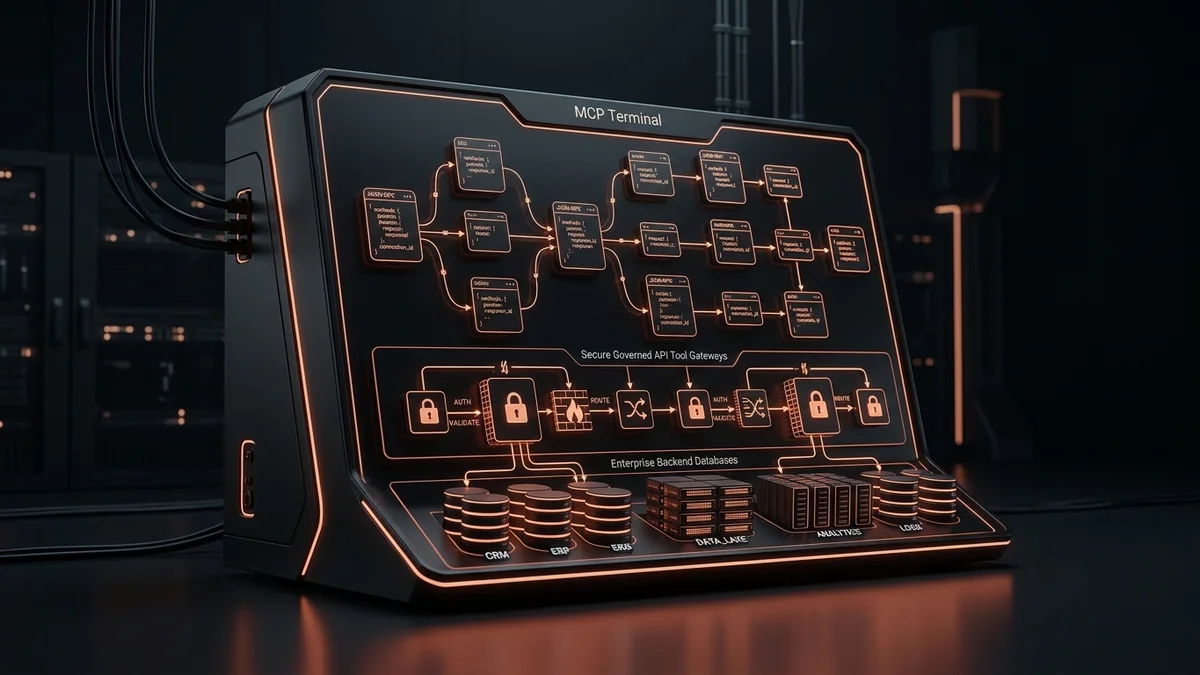
An AI agent is only as useful as what it can reach. Custom MCP Server Development wraps internal systems — a Laravel database, a CRM, a support inbox — behind the Model Context Protocol, so Claude, ChatGPT, or Gemini can call real business data through one governed interface instead of a pile of one-off scripts.
Table of Contents
- Your AI Agent Can't See Your Business
- What MCP Actually Standardizes
- Building on a Laravel Backend
- Trade-Offs Nobody Mentions in the Demo
- Why This Is a Safe Bet Now
- Where This Fits Your Stack
- FAQ
Your AI Agent Can't See Your Business
Every founder who's plugged an AI assistant into their workflow hits the same wall. The model writes great copy — then ask it whether order #4821 shipped, and it has nothing. No connection to your Laravel app, your Postgres tables, your support queue. Teams patch this with a script per tool, a webhook here, a scraped export there. Six months on, nobody remembers which script talks to what.
Custom MCP Server Development kills that pattern. Anthropic released the Model Context Protocol as an open standard in November 2024, giving AI clients one way to call tools, resources, and prompts from any backend instead of a bespoke plugin per vendor (MCP Blog, "One Year of MCP").
What MCP Actually Standardizes
MCP runs JSON-RPC 2.0 over STDIO or HTTP between a "host" — Claude Desktop, an IDE, your own agent — and one or more servers. Each exposes three primitives: tools (functions the model can call), resources (read-only content), and prompts (reusable templates). The model never touches raw credentials; it sees only what your server exposes.
flowchart LR
    A[AI Client] -->|JSON-RPC 2.0| B[Your MCP Server]
    B --> C[Tools]
    B --> D[Resources]
    C --> E[Laravel + Postgres]
    D --> E
That boundary is the point. AI Agent Workflow Automation built on ad-hoc scripts has no consistent permission model — one reads, another writes, a third has admin creds nobody scoped down. An MCP server forces you to define, upfront, what an agent can touch.
Building on a Laravel Backend
This is where LLM Tool Integration Laravel gets concrete. The MCP org ships an official PHP SDK with The PHP Foundation; php-mcp/laravel wraps it for PHP 8.1+ / Laravel 10+ (README). Tools declare via PHP 8 attributes:
#[McpTool(name: 'checkOrderStatus')]
public function checkOrderStatus(int $orderId): array
{
    return Order::findOrFail($orderId)->only(['status', 'eta']);
}
#[McpResource] exposes read-only content; #[McpPrompt] ships templates with the code behind them. Three transports ship built-in — STDIO for local IDE use, an integrated HTTP route, or a dedicated server for production — all via php artisan mcp:serve. On a stack running Articles/Coding/Laravel and structured around Clean Architecture, the tool layer is another bounded service, not a bolt-on.
Trade-Offs Nobody Mentions in the Demo
The demo shows one tool, one happy path. Production isn't.
A createInvoice tool should not also delete customers. A misfired or injected tool call is bounded by what that one tool can do — nothing more.
- Auth is per-connection. HTTP servers need their own token or OAuth layer, or you've built an unauthenticated API and called it MCP.
- Rate limits matter more. An agent can loop a tool call far faster than a human clicking a UI — and a full table dumped as one resource burns context, so page it.
- Transport is a deployment call. STDIO suits a dev session; client-facing agents want a real HTTP server.
Why This Is a Safe Bet Now
The adoption curve answers the "will this exist next year" objection. OpenAI added native MCP support in March 2025 (TechCrunch); Google followed weeks later (TechCrunch). By its first anniversary, the official registry — launched September 2025 — had grown to roughly two thousand servers, a 407% increase in one quarter, backed by 58 maintainers (MCP Blog). That December, OpenAI, Anthropic, and Block joined a Linux Foundation effort for neutral governance (TechCrunch) — three rival labs, one open standard.
Where This Fits Your Stack
MCP is the connective layer, not the whole strategy. n8n Automatisierung Agentur Deutschland pipelines still handle scheduled batch jobs; MCP servers handle live, governed access mid-conversation. We covered orchestration in our MCP-driven workflow piece, the harness layer in our agent swarm breakdown, and portable tool definitions in our multi-model skills piece.
Most clients start as one Individualsoftware entwickeln lassen engagement — two or three tools wrapping the systems that matter, not a rebuild. Teams needing Geschäftsprozesse Automatisieren Agentur work across several systems get that scoped as Software Development: the boring, well-governed option, same as framework selection generally.
FAQ
Do we need to rewrite our backend to add an MCP server? No — it sits alongside your app as new routes or a separate process.
Can an MCP server write data, or only read it? Both. Tools mutate data; resources are read-only, so writes stay auditable through explicit tools.
Is MCP specific to Claude? No. Claude, ChatGPT, Gemini, and most IDEs support it as of 2026 — why it's worth building on the open standard.
Follow Masri Systems on Google
Add us as a preferred source in Google Search.
Related Articles & Guides
AI Agent Workflow Automation: Curated 123-Tool Stack
Curated directory of 123 open-source AI agent frameworks, MCP servers, and developer tools for production AI agent workflow automation and autonomous systems.
Geschäftsprozesse automatisieren: 17 Scheduled Tasks der Agentur
Wie Masri Systems 17 autonome Agenten-Jobs, Sidecars und Cron-Tasks einsetzt, um Geschäftsprozesse im Entwickler-Alltag wartungsfrei zu automatisieren.
Command Center: Autonome KI Agenten Geschäftsprozesse KMU steuern
Autonome KI Agenten Geschäftsprozesse KMU: Steuern Sie Gemini, Codex und Claude parallel in einem sicheren VILT Stack Command Center mit OS-Locking.

Portable AI Agent Skills: One Skill, Every Model
Stop rewriting the same AI agent workflow for Claude, Gemini, and Codex. Build portable skills once with AI Agent Workflow Automation and sync everywhere.

Openship: A Self-Hosted Deployment Platform With No CI/CD Pipeline
Openship is an Apache 2.0 self-hosted deployment platform that skips CI/CD YAML. What v0.6.7 does well, and why pre-1.0 status should shape your rollout.
Why PHP 8.4 & Laravel Are the Smartest Choice for Web Apps
Explore modern PHP web development. Discover why PHP 8.4 performance, strict typing, JIT compilation, and Laravel make PHP the top choice for software teams.

Website SEO & AI Search Engines
Master website SEO & AI search engines. Automate instant IndexNow submissions to Bing and AI crawlers using GitHub Actions, curl, and automated sitemap.
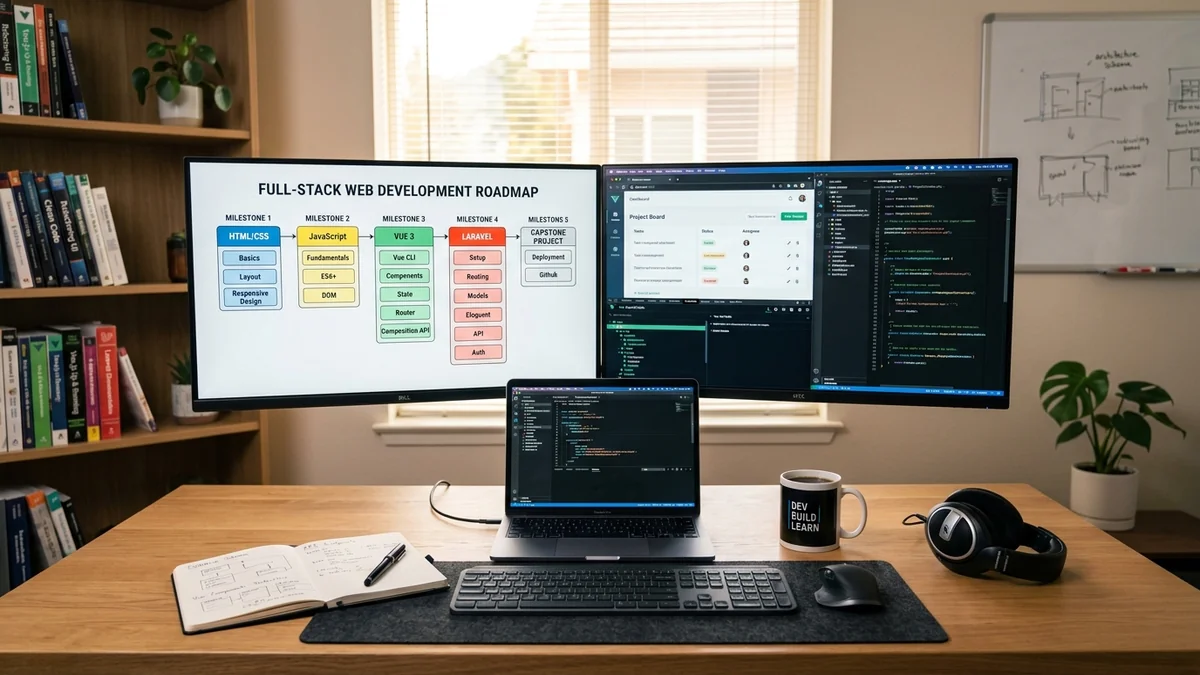
Web Development Curriculum: Full
Master full-stack web development. Comprehensive curriculum covering HTML/CSS/Tailwind, ES6+ JavaScript, Vue 3 & Vite, Laravel APIs, and CI/CD deployment.