
Sectors of Computer Science & Software Engineering

Computing spans far beyond generic coding. From foundational computer science theory and large-scale software engineering to specialized tracks in AI, cloud infrastructure, embedded systems, and cybersecurity, this guide maps out every major sector, career path, and the modern AI tooling required to excel.
A complete guide to navigating the core disciplines of computer science, modern tech career paths, specialized engineering tracks, and high-leverage developer tooling.
1. Computer Science & Academic Disciplines
Understanding the scope of computing begins with distinguishing the three fundamental academic disciplines:
graph TD
    A["Computing Disciplines"] --> B["Computer Science (CS)"]
    A --> C["Software Engineering (SE)"]
    A --> D["Information Technology (IT)"]

    B --> B1["Computational Theory, Algorithms & Data Structures"]
    C --> C1["System Design, Testing & Lifecycle Maintenance"]
    D --> D1["Infrastructure, Networking & Database Administration"]
Computer Science (CS)
- Primary Focus: Theoretical computing foundations, discrete mathematics, algorithm complexity analysis, and general programming paradigms.
- Core Study Areas: Computability, automata theory, data structures, compiler design, artificial intelligence, and operating systems.
- Outcome: Deep theoretical intuition for solving algorithmic and computational problems from first principles.
Software Engineering (SE)
- Primary Focus: The structured, engineering-driven design, construction, testing, and lifecycle maintenance of large-scale software systems.
- Core Study Areas: Software architecture, clean design patterns, agile methodologies, requirements engineering, quality assurance, and team collaboration.
- Outcome: Ability to reliably build, maintain, and scale complex codebases across multi-engineer teams.
Information Technology (IT)
- Primary Focus: The operational deployment, management, and security of hardware, server infrastructure, enterprise databases, and networks.
- Core Study Areas: Systems administration, network topologies, enterprise security, cloud administration, and hardware virtualization.
- Outcome: Keeping production environments secure, available, and performant.
2. Core Tech Career Paths
Modern technology organizations structure technical talent into four high-impact career verticals:
graph TD
    A["Tech Career Paths"] --> B["Software Developer / Engineer"]
    A --> C["Data Scientist / Analyst"]
    A --> D["Cybersecurity Analyst / Engineer"]
A --> E["AI & Machine Learning Engineer"]- Software Developer / Software Engineer: Designs, builds, and maintains applications, web systems, mobile clients, and distributed backends.
- Data Scientist / Data Analyst: Collects, transforms, and analyzes large datasets to extract actionable business intelligence and predictive patterns.
- Cybersecurity Analyst / Security Engineer: Protects networks, data, and systems against vulnerabilities, cyberattacks, and security breaches.
- AI / Machine Learning Engineer: Researches, trains, and deploys predictive models, deep neural networks, and autonomous AI agents.
3. Experience Progression & Seniority Funnel
Career advancement is evaluated by the scope of technical ambiguity you can independently resolve:
flowchart TD
    A["Junior (0–2 Years): Master syntax, unit tests, and local debugging"] --> B["Mid-Level (2–5 Years): Independent module ownership & API contracts"]
    B --> C["Senior (5+ Years): System architecture, cross-service reliability & mentorship"]
C --> D["Staff / Principal Architect: Cross-organization tech vision & strategic infrastructure"]- Junior Engineer (0–2 Years): Learns the existing codebase, resolves focused bug tickets, and writes well-tested features under senior guidance.
- Mid-Level Engineer (2–5 Years): Works independently, designs features, crafts clear API contracts, and actively reviews team pull requests.
- Senior Engineer (5+ Years): Solves ambiguous architectural challenges, leads scalable database schema design, authors technical RFCs, and mentors engineers.
- Staff / Principal Architect: Drives multi-team technical vision, establishes company-wide engineering standards, and evaluates infrastructure trade-offs.
4. The Sectors of Computer Science & Software Engineering
Software engineering branches into distinct specialization domains, each demanding tailored mental models and toolsets:
mindmap
  root((Computing Sectors))
    Web & Mobile
      Frontend Web
      Backend Architecture
      Fullstack Systems
      Mobile Engineering
    Data & Analytics
      Data Science
      Data Engineering
      Business Intelligence
    AI & Machine Learning
      Deep Learning & NLP
      Autonomous Agents & Swarms
      Model Context Protocol
    Cloud & Infrastructure
      DevOps & CI/CD
      Container Orchestration
      Site Reliability Engineering
    Embedded & Hardware
      Microcontrollers & RTOS
      Internet of Things
      Robotics
    Cybersecurity
      Application Security
      Penetration Testing
      DevSecOps
    Game Development
      Game Engines
      Graphics & Shaders
      Physics Simulation
    Quality & Testing
      Automated Testing
      Performance & Load Testing
      Chaos Engineering
Sector 1: Web & Mobile Engineering
- Frontend Web (Client-Side):
- React Meta-Stack: React, Next.js, Remix
- Vue Ecosystem: Vue 3, Nuxt, Pinia
- Angular Architecture: Standalone components, RxJS, TypeScript
- Zero-JS / Static Engines: Astro, Vite, Svelte
- Backend Architecture (Server-Side):
- PHP / Modern Monoliths: Laravel, Inertia.js, Filament, Symfony
- TypeScript & Node.js: NestJS, Express, Fastify
- Go (Golang): Gin, Fiber, high-throughput microservices
- Python: FastAPI, Django, Flask
- Java & C# / .NET: Spring Boot, ASP.NET Core
- Mobile Engineering:
- Native iOS: Swift, SwiftUI
- Native Android: Kotlin, Jetpack Compose
- Cross-Platform: Flutter (Dart), React Native (TypeScript)
Sector 2: Cloud Infrastructure, DevOps & SRE
- Core Disciplines: Continuous Integration / Continuous Deployment (CI/CD), infrastructure as code, container orchestration, and telemetry.
- Key Tooling: Docker, Kubernetes, Terraform, Ansible, GitHub Actions, AWS, Google Cloud, Hetzner, Prometheus, Grafana.
Sector 3: Artificial Intelligence & Autonomous Agents
- Core Disciplines: Large Language Model (LLM) orchestration, prompt engineering, agent swarms, vector search, and API bridges.
- Key Tooling: PyTorch, Hugging Face, LangChain, LlamaIndex, Model Context Protocol (MCP), Claude Code, Gemini CLI.
Sector 4: Data Science & Data Engineering
- Core Disciplines: High-volume data streaming, ETL/ELT pipelines, distributed processing, and analytical modeling.
- Key Tooling: Apache Spark, Apache Kafka, PostgreSQL, DuckDB, Snowflake, BigQuery, Pandas, NumPy.
Sector 5: Cybersecurity & Information Assurance
- Core Disciplines: Cryptography, vulnerability management, secure coding standards (OWASP Top 10), identity and access management (IAM), and penetration testing.
- Key Tooling: Wireshark, Burp Suite, Metasploit, SonarQube, OpenVAS, HashiCorp Vault.
Sector 6: Embedded Systems, IoT & Robotics
- Core Disciplines: Hardware-software interfaces, memory-constrained environments, interrupt handling, and sensor integration.
- Key Tooling: C, C++, Rust, ARM Cortex, ESP32, Arduino, Raspberry Pi, FreeRTOS.
Sector 7: Game Development & Computer Graphics
- Core Disciplines: Real-time 3D rendering, shader programming, spatial audio, physics simulation, and game mechanics.
- Key Tooling: Unreal Engine (C++), Unity (C#), Godot (GDScript / C#), OpenGL, Vulkan, HLSL/GLSL.
Sector 8: Software Quality & Reliability Engineering
- Core Disciplines: Test-driven development (TDD), end-to-end browser automation, load/stress testing, and regression suites.
- Key Tooling: Pest, PHPUnit, Playwright, Cypress, Vitest, Jest, k6, JMeter.
5. Modern AI Workspaces & Productivity Harnesses
Top engineers treat AI assistants as cognitive force multipliers across research, architecture, and verification:
Use AI tools for rapid prototyping, RFC exploration, and test generation, but always verify architectural decisions and edge-case behaviors against system invariants.
| Workspace / Tool | Primary Strengths & Use Cases |
|---|---|
| Odysseus AI | Self-hosted, private AI workspace and document reasoning harness. |
| Claude (Anthropic) | Deep architectural reasoning, long-context code refactoring, and deterministic agent execution via Claude Code. |
| ChatGPT (OpenAI) | Rapid ideation, exploratory debugging, and versatile conceptual synthesis. |
| DeepSeek | High-performance open-weight mathematical reasoning and code synthesis. |
| Qwen | Powerful multilingual open-source code and document reasoning. |
| Manus & Kimi | Autonomous agent exploration, deductive reasoning, and workflow automation. |
| Microsoft 365 Copilot | Enterprise collaboration, documentation drafting, and communication synthesis. |
6. Related References & Navigation
- Career Paths & Developer Tools — Software engineer career roadmap and progression funnel.
- Helpful Resources I Collected in Bachelor's — Curated academic engineering toolkit and practice sandboxes.
- Clean Architecture — Architectural principles for scalable software design.
- Work Logs — Engineering work logs and feedback loop maintenance.
Follow Masri Systems on Google
Add us as a preferred source in Google Search.
Related Articles & Guides
AI Agent Workflow Automation: Curated 123-Tool Stack
Curated directory of 123 open-source AI agent frameworks, MCP servers, and developer tools for production AI agent workflow automation and autonomous systems.
Free Developer Certifications: 5 High-Impact Courses & Badges
5 verifiable free developer certifications and coding courses from Postman, Google Cloud, DeepLearning.AI, and freeCodeCamp to elevate your engineering resume.
Command Center: Autonome KI Agenten Geschäftsprozesse KMU steuern
Autonome KI Agenten Geschäftsprozesse KMU: Steuern Sie Gemini, Codex und Claude parallel in einem sicheren VILT Stack Command Center mit OS-Locking.

Portable AI Agent Skills: One Skill, Every Model
Stop rewriting the same AI agent workflow for Claude, Gemini, and Codex. Build portable skills once with AI Agent Workflow Automation and sync everywhere.

Software Engineer Career Roadmap
Explore the complete software engineer career roadmap. Master junior to senior transitions, high-demand tech specializations, and modern AI development.

Why PHP 8.4 & Laravel Are the Smartest Choice for Web Apps
Explore modern PHP web development. Discover why PHP 8.4 performance, strict typing, JIT compilation, and Laravel make PHP the top choice for software teams.
Web Development Utilities: 10 Essential Free Browser Tools
Master essential web development utilities. Discover 10 free online tools for JSON formatting, JWT decoding, HAR network analysis, Base64, and CSV/YAML.
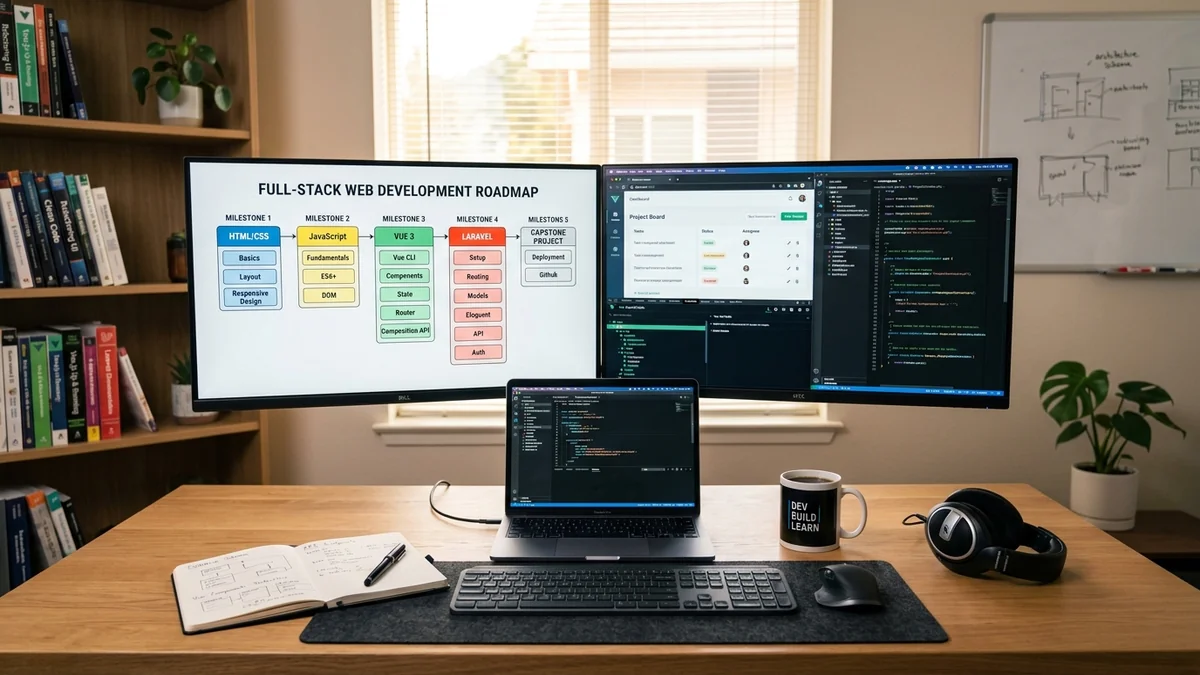
Web Development Curriculum: Full
Master full-stack web development. Comprehensive curriculum covering HTML/CSS/Tailwind, ES6+ JavaScript, Vue 3 & Vite, Laravel APIs, and CI/CD deployment.