
Software Engineering Laws & Principles

Software development challenges are rarely purely technical—they are psychological, organizational, and systemic. Understanding foundational software engineering laws & principles equips developers and engineering managers with the mental models required to accurately estimate timelines, design decoupled system architectures, and scale development teams without degrading velocity.
Table of Contents
- The Hidden Dynamics of Software Systems
- Pillar 1: Estimation, Time & Delivery Dynamics
- Pillar 2: Architecture & Organizational Topology
- Visualizing the Architectural Conway Loop
- Pillar 3: Team Velocity & Metric Governance
- Frequently Asked Questions
- Conclusion & Next Steps
- Sources & Image Attributions
The Hidden Dynamics of Software Systems
Software engineering projects frequently face delayed deadlines, unexpected system regressions, and bloated feature sets. These recurring patterns are not random anomalies; they reflect fundamental laws of human communication, cognitive limits, and distributed system design.
Mastering software engineering laws & principles allows technical leaders to predict bottlenecks before they emerge. By grounding architectural decisions in proven mental models alongside structural disciplines like Clean Architecture and Apply the 80-20 Principle for Productivity, engineering organizations achieve sustainable delivery cadence.
Pillar 1: Estimation, Time & Delivery Dynamics
Managing deadlines and delivery expectations requires navigating three classic estimation laws:
- Parkinson’s Law: Work expands to fill the available time. Setting loose, open-ended sprint goals leads to gold-plating; concise time-boxes encourage ruthless prioritization of core requirements.
- Hofstadter’s Law: It always takes longer than you expect, even when you take into account Hofstadter’s Law. Software development is exploratory research; unforeseen edge cases inevitably emerge during implementation.
- Brooks’ Law: Adding manpower to a late software project makes it later. Onboarding new engineers consumes the bandwidth of senior developers and multiplies communication pathways ($N(N-1)/2$).
Pillar 2: Architecture & Organizational Topology
System interfaces naturally mirror the human communication networks behind them:
- Conway’s Law: Organizations design systems that mirror their own communication structures. If frontend and backend teams are isolated, APIs become rigid and awkward. Apply the Inverse Conway Maneuver by forming cross-functional product pods to achieve clean micro-architectures.
- Hyrum’s Law (The Law of Implicit Interfaces): With sufficient users, every observable behavior of your system will be depended on by someone. Never rely solely on documented contracts; assume clients depend on undocumented response orders and error strings.
- Zawinski’s Law: Every program attempts to expand until it can read mail. Software naturally accumulates feature bloat unless actively trimmed by product discipline.

Visualizing the Architectural Conway Loop
Aligning organizational communication directly dictates technical boundary resilience:
flowchart LR
    A["Team Communication Topology"] --> B["System Architecture & Interface Design"]
    B --> C["API Contracts & Service Boundaries"]
    C --> D{"Inverse Conway Maneuver"}
D -->|Restructure Pods| AStructure your development teams around bounded contexts rather than technical layers. Cross-functional squads (Frontend + Backend + QA) produce cohesive APIs, while siloed layer teams produce fractured, bloated middleware.
Pillar 3: Team Velocity & Metric Governance
Managing performance metrics without distorting developer incentives requires navigating organizational traps:
- Goodhart’s Law: When a metric becomes a target, it ceases to be a good metric. Measuring lines of code incentives verbose bloat; targeting ticket counts leads to trivial micro-commits.
- Gilb’s Law: Anything you need to quantify can be measured in some way superior to not measuring it at all. Combine qualitative feedback with DORA metrics rather than surrendering to unmeasured chaos.
- Price’s Square Root Law: In any organization, 50% of the work is generated by the square root of the total headcount ($\sqrt{N}$). In a team of 25, roughly 5 key contributors drive half the output.
- Ringelmann Effect: Individual productivity declines as group size expands. Combat social loafing by keeping autonomous project pods small (the Amazon "two-pizza team" rule).
- Cunningham’s Law: The fastest way to get the correct answer online is to post the wrong answer. When waiting for architectural feedback, submit an imperfect draft pull request to stimulate rapid critique.
- Sturgeon’s Law: 90% of everything is low quality. Focus engineering bandwidth strictly on the 10% of high-impact features that drive actual user value.
- Murphy’s Law: Anything that can go wrong will go wrong. Build zero-trust defensive error handling into every external API and network boundary.
Frequently Asked Questions
How can engineering managers combat Brooks' Law during project delays?
Instead of adding new developers, reduce scope, defer non-essential features, and protect the existing core engineering team from external meeting interruptions.
What is the practical application of Goodhart's Law in agile sprints?
Track multiple balanced indicators (e.g., Cycle Time, Change Failure Rate, and Team Morale) rather than evaluating individual developers on a single number like velocity points.
How do these principles integrate with personal developer habits?
Documenting architectural decisions in a personal Engineering Work Logs System and structuring personal research with OmniVault AI The Developers Second Brain helps engineers apply these laws empirically.
Conclusion & Next Steps
Great software engineering is as much about human systems as it is about syntax. By incorporating these foundational software engineering laws & principles, you navigate architectural complexity and lead technical teams with clarity.
At Masri Systems, we architect high-performance digital platforms with clean, decoupled structures. Explore our specialized Software Development and Clean Architecture services to see how we build resilient digital infrastructure.
Sources & Image Attributions
- Header Image: Software engineering team discussing technical roadmap by Annie Spratt on Unsplash
- Body Image: Developer planning system architecture on whiteboard by UX Indonesia on Unsplash
Follow Masri Systems on Google
Add us as a preferred source in Google Search.
Related Articles & Guides

Free Developer Certifications: 5 High-Impact Courses & Badges
5 verifiable free developer certifications and coding courses from Postman, Google Cloud, DeepLearning.AI, and freeCodeCamp to elevate your engineering resume.

Geschäftsprozesse automatisieren: 17 Scheduled Tasks der Agentur
Wie Masri Systems 17 autonome Agenten-Jobs, Sidecars und Cron-Tasks einsetzt, um Geschäftsprozesse im Entwickler-Alltag wartungsfrei zu automatisieren.

Sectors of Computer Science & Software Engineering
Explore the primary disciplines of computer science, tech career paths, software engineering specialization tracks, and modern developer tooling.

Software Engineer Career Roadmap
Explore the complete software engineer career roadmap. Master junior to senior transitions, high-demand tech specializations, and modern AI development.

Why PHP 8.4 & Laravel Are the Smartest Choice for Web Apps
Explore modern PHP web development. Discover why PHP 8.4 performance, strict typing, JIT compilation, and Laravel make PHP the top choice for software teams.
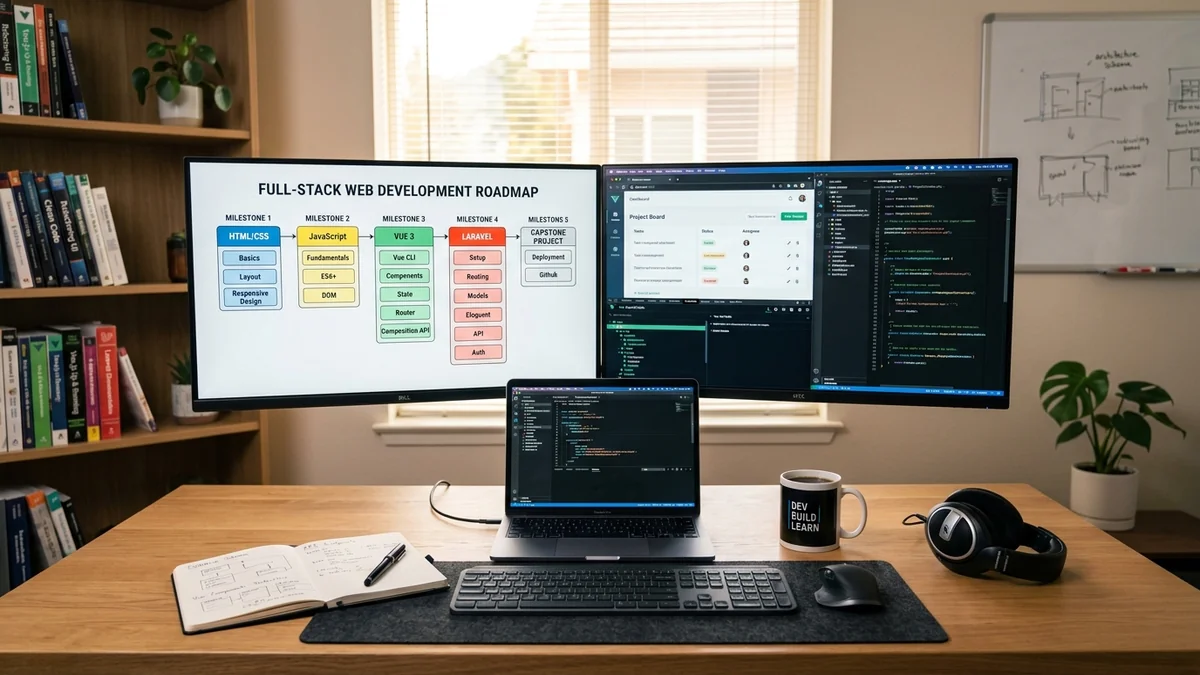
Web Development Curriculum: Full
Master full-stack web development. Comprehensive curriculum covering HTML/CSS/Tailwind, ES6+ JavaScript, Vue 3 & Vite, Laravel APIs, and CI/CD deployment.

Was ist eine Homepage Erklärung
Was ist eine Homepage Erklärung: Erfahren Sie den entscheidenden Unterschied zur Website, die 3 Kernaufgaben einer Startseite und den perfekten Seitenaufbau.

Vue JS Application Architecture
Master Vue JS application architecture. Comprehensive scaffolding guide covering TypeScript interfaces, modular directory structure, Pinia, and VueUse.