
Vue JS Application Architecture

Structuring a large-scale Vue 3 application requires thoughtful architectural boundaries. This comprehensive guide to Vue JS Application Architecture defines a modular enterprise directory layout, configures TypeScript interfaces & Composition API composables, integrates Tailwind CSS utilities, and sets up Pinia state management for long-term maintainability.
Table of Contents
- The Challenge of Scaling Single-Page Applications
- 4 Core Pillars of Scalable Vue JS Application Architecture
- Visualizing the Modular Vue 3 Architecture
- Enterprise Directory Layout Blueprint
- Frequently Asked Questions
- Conclusion & Next Steps
- Sources & Image Attributions
The Challenge of Scaling Single-Page Applications
When building small Vue prototypes, placing all components in a flat /components directory works fine. However, as applications scale to dozens of domain models, role-based auth guards, and multi-step workflows, flat folder structures turn into unmaintainable spaghetti code.
Adopting a robust Vue JS Application Architecture establishes modular domain boundaries. By grouping components, composables, stores, and API services by business feature rather than technical type, development teams scale codebases cleanly across multiple engineers.
Pairing structured Vue architecture with foundational standards from Clean Architecture and backend integration from VILT Stack AI Development guarantees high engineering velocity.
4 Core Pillars of Scalable Vue JS Application Architecture
Enterprise Vue 3 applications are engineered around four foundational principles:
1. Domain-Driven Modular Layout
Group code by functional domain (e.g., modules/auth/, modules/dashboard/, modules/billing/) containing domain-specific components, views, and Pinia stores.
2. Composition API & Reusable Composables
Encapsulate stateful logic inside dedicated composables (useAuth.ts, useFetch.ts) rather than mixing logic directly in single-file component template scripts.
3. Strict TypeScript Contracts & Validation
Define strict TypeScript interfaces for all component props and pair with schema validation libraries (Yup or Zod) for form data validation.
4. Layout Abstractions & Navigation Guards
Use persistent layout wrappers (DefaultLayout.vue, AdminLayout.vue) and Vue Router middleware pipelines to enforce role-based authentication deterministically.

Visualizing the Modular Vue 3 Architecture
How application modules communicate with shared core infrastructure:
flowchart TD
    A["App Root (main.ts & App.vue)"] --> B["Vue Router & Auth Middleware"]
    B --> C["Layout Wrappers (Admin / Auth / Default)"]
    C --> D["Feature Domain Modules (Dashboard / Users / Billing)"]
    D --> E["Domain Components & Views"]
    D --> F["Domain Pinia Stores"]
D --> G["Shared Core (Composables / API Client / UI Primitives)"]Always return refs or getters from composables, not raw reactive objects. Returning explicit refs ensures destructured variables preserve reactivity across parent components.
Enterprise Directory Layout Blueprint
Here is the standardized directory layout for enterprise Vue 3 applications:
src/
├── assets/             # Global CSS variables, Tailwind stylesheets, images
├── components/         # Shared global UI primitives (Button, Modal, Input)
├── composables/        # Global reusable composables (useAuth, useToast)
├── layouts/            # Page layouts (DefaultLayout, AdminLayout, AuthLayout)
├── middleware/         # Vue Router navigation guards (auth, guest, admin)
├── modules/            # Feature-specific domains (dashboard, users, billing)
│   └── users/
│       ├── components/ # UserCard.vue, UserForm.vue
│       ├── views/      # UserListView.vue, UserDetailView.vue
│       └── store.ts    # useUserStore.ts
├── router/             # Central router configuration and modular route maps
├── services/           # Axios HTTP client instances and API endpoint definitions
└── utils/              # Pure helper functions, formatting, and constants
Frequently Asked Questions
Why should I choose Pinia over Vuex for state management?
Pinia is the official state management library for Vue 3. It offers full TypeScript auto-completion, zero mutations boilerplate, modular store definitions, and lightweight bundle size.
How do I handle internationalization (i18n) in large Vue apps?
Use vue-i18n and split translation dictionaries by locale into separate JSON files (locales/en.json, locales/de.json) loaded asynchronously on demand.
What is the best way to manage shared API calls?
Create centralized service classes using Axios or $fetch with interceptors that automatically attach Bearer tokens and handle 401 unauthorized redirects globally.
Conclusion & Next Steps
Adopting a structured Vue JS Application Architecture ensures your frontend code remains modular, testable, and effortless to navigate as features grow. By establishing clear domain boundaries, software teams deliver exceptional digital platforms.
At Masri Systems, we architect high-performance Vue and Nuxt applications, custom SaaS platforms, and enterprise digital solutions. Explore our specialized Software Development and Website Architecture services to build scalable digital systems for modern enterprises.
Sources & Image Attributions
- Header Image: Developer working on code by Caspar Camille Rubin on Unsplash
- Body Image: Developer working at desk by Domenico Loia on Unsplash
Follow Masri Systems on Google
Add us as a preferred source in Google Search.
Related Articles & Guides

Free Developer Certifications: 5 High-Impact Courses & Badges
5 verifiable free developer certifications and coding courses from Postman, Google Cloud, DeepLearning.AI, and freeCodeCamp to elevate your engineering resume.

Geschäftsprozesse automatisieren: 17 Scheduled Tasks der Agentur
Wie Masri Systems 17 autonome Agenten-Jobs, Sidecars und Cron-Tasks einsetzt, um Geschäftsprozesse im Entwickler-Alltag wartungsfrei zu automatisieren.
The New Masri Systems Logo: Brand Identity for Custom Website Design
Explore the engineering and design philosophy behind the new Masri Systems logo mark, custom website design systems, and architectural identity.

Why PHP 8.4 & Laravel Are the Smartest Choice for Web Apps
Explore modern PHP web development. Discover why PHP 8.4 performance, strict typing, JIT compilation, and Laravel make PHP the top choice for software teams.

Webdesign Portfolio Inspiration
Discover top webdesign portfolio inspiration. Explore curated developer showcases, creative agency landing pages, and best practices for conversion and UI.

Web Development Utilities: 10 Essential Free Browser Tools
Master essential web development utilities. Discover 10 free online tools for JSON formatting, JWT decoding, HAR network analysis, Base64, and CSV/YAML.
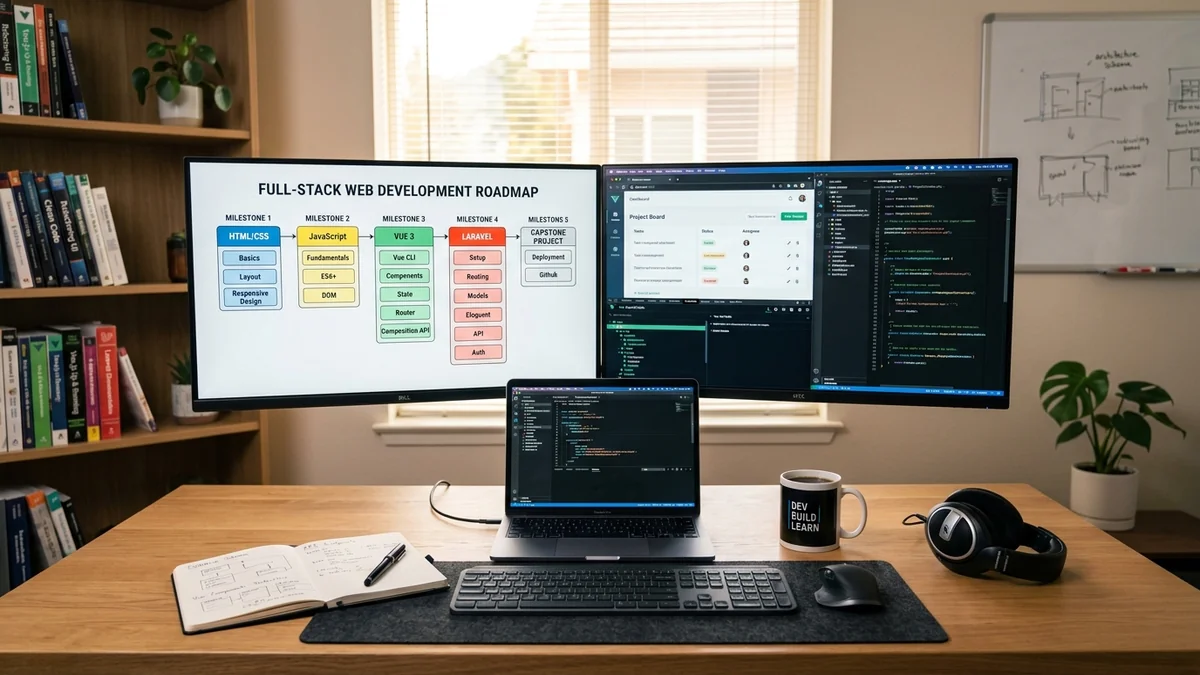
Web Development Curriculum: Full
Master full-stack web development. Comprehensive curriculum covering HTML/CSS/Tailwind, ES6+ JavaScript, Vue 3 & Vite, Laravel APIs, and CI/CD deployment.

Web Application Performance Optimization
Boost backend and frontend speed with actionable web application performance optimization tactics. Eliminate N+1 queries, memory leaks, and CPU cache misses.