
Building the Ultimate Developer Second Brain in Obsidian

Navigating modern software engineering requires managing immense cognitive load. Building a developer second brain in Obsidian with OmniVault AI combines the structured PARA method with AI-native agent orchestration, turning scattered code snippets, architecture RFCs, and daily logs into a compounding knowledge ecosystem.
Table of Contents
- The Engineer's Information Dilemma
- Architectural Foundation: PARA for Technical Teams
- AI-Native Knowledge Systems & Agent Orchestration
- Visualizing the OmniVault Knowledge Pipeline
- High-Density "Bento Box" Dashboards & Metrics
- Frequently Asked Questions
- Conclusion & Next Steps
- Sources & Image Attributions
The Engineer's Information Dilemma
Software engineers process hundreds of technical documents, stack traces, and library release notes every week. Without a centralized storage and retrieval mechanism, critical implementation learnings vanish into disconnected browser tabs and buried terminal outputs.
Constructing a developer second brain in Obsidian resolves this mental tax. By combining local-first markdown storage, bidirectional wikilinks, and customized AI tooling, engineers establish an external memory bank that accelerates problem resolution and system architecture.
Pairing structured personal knowledge with foundational development practices—such as Apply the 80-20 Principle for Productivity and Clean Architecture—ensures engineering insights compound over entire career lifecycles.
Architectural Foundation: PARA for Technical Teams
At the core of the OmniVault architecture lies a specialized adaptation of Tiago Forte's PARA framework, redesigned specifically for engineering workflows:
- 10_Actions: Live project workspaces, active sprints, and task kanbans directly tied to codebase tickets.
- 20_Areas: Long-term engineering domains such as System Reliability, DevOps infrastructure, and team mentoring.
- 30_Knowledge: A digital slipbox containing technical notes, RFC archives, and Maps of Content (MOCs).
- 40_Journal: An empirical tracking hub using structured Engineering Work Logs System templates to monitor daily focus and blockers.
- 95_AI: The system orchestration layer hosting LLM prompts, agent instructions, and MCP server endpoints.

AI-Native Knowledge Systems & Agent Orchestration
A modern second brain must be legible to both human engineers and automated AI agents. OmniVault structures metadata with standardized YAML properties and explicit tagging rules, enabling local and cloud-based AI tools to read and update notes smoothly.
Through Model Context Protocol (MCP) integrations and local LLM tooling (such as Ollama), engineers can query their vault semantically:
- Instant Code Synthesis: Extract past architectural decisions across projects to inform new backend designs.
- Automated Note Linking: Allow AI agents to suggest bidirectional wikilinks between disparate debugging records.
- System Prompts as Code: Maintain version-controlled prompts directly alongside system documentation.
Visualizing the OmniVault Knowledge Pipeline
Information moves through a structured capture-to-execution pipeline that eliminates knowledge rot:
flowchart LR
    A["Raw Inputs (Articles, Bugs, RFCs)"] --> B["OmniVault Inbox (10_Actions)"]
    B --> C["PARA Classification & Metadata Tagging"]
    C --> D["AI Agent Semantic Indexing (MCP / Ollama)"]
D --> E["Compounded Knowledge & Instant Retrieval"]Store all technical notes in plain Markdown files on your local drive. Proprietary cloud databases risk vendor lock-in, while plain-text vaults guarantee your second brain remains accessible and scriptable for decades.
High-Density "Bento Box" Dashboards & Metrics
Information accessibility determines system adoption. OmniVault utilizes DataviewJS and Meta Bind to render a clean, high-density dashboard that acts as an engineering control center:
- Active Sprint Status: Real-time visibility into active repositories and open pull requests.
- Focus Windows & Ultradian Logging: Metric trackers that log uninterrupted development blocks and mitigate developer fatigue.
- Recently Synthesized RFCs: Automated dynamic lists highlighting recent technical findings and reusable design patterns.
Frequently Asked Questions
Why choose Obsidian over cloud tools like Notion for a developer second brain?
Obsidian operates directly on local Markdown files, providing zero latency, complete data privacy, offline capabilities, and seamless Git version control—critical for engineering workflows.
How much time does it take to maintain an OmniVault setup?
By using structured templates and automated Daily Notes, maintenance takes less than 10 minutes a day during morning planning and evening shutdown rituals.
Can I connect Obsidian directly to my IDE and AI agents?
Yes. With modern MCP servers and CLI utilities, you can bridge your Obsidian vault with VS Code, Cursor, and terminal agents for bidirectional knowledge retrieval.
Conclusion & Next Steps
Building a dedicated developer second brain in Obsidian transforms scattered technical learning into a structured, searchable competitive advantage. By offloading cognitive overhead to an AI-native vault, engineers can focus on deep problem solving and rapid execution.
At Masri Systems, we architect high-performance digital platforms and custom automation systems. Explore our comprehensive Software Development and Consulting & Strategy services to discover how we build scalable digital solutions for growing enterprises.
Sources & Image Attributions
- Header Image: Abstract digital technology background by Markus Spiske on Unsplash
- Body Image: Minimalist workspace setup with laptop by Domenico Loia on Unsplash
Follow Masri Systems on Google
Add us as a preferred source in Google Search.
Related Articles & Guides
AI Agent Workflow Automation: Curated 123-Tool Stack
Curated directory of 123 open-source AI agent frameworks, MCP servers, and developer tools for production AI agent workflow automation and autonomous systems.
Geschäftsprozesse automatisieren: 17 Scheduled Tasks der Agentur
Wie Masri Systems 17 autonome Agenten-Jobs, Sidecars und Cron-Tasks einsetzt, um Geschäftsprozesse im Entwickler-Alltag wartungsfrei zu automatisieren.
Command Center: Autonome KI Agenten Geschäftsprozesse KMU steuern
Autonome KI Agenten Geschäftsprozesse KMU: Steuern Sie Gemini, Codex und Claude parallel in einem sicheren VILT Stack Command Center mit OS-Locking.

Sectors of Computer Science & Software Engineering
Explore the primary disciplines of computer science, tech career paths, software engineering specialization tracks, and modern developer tooling.
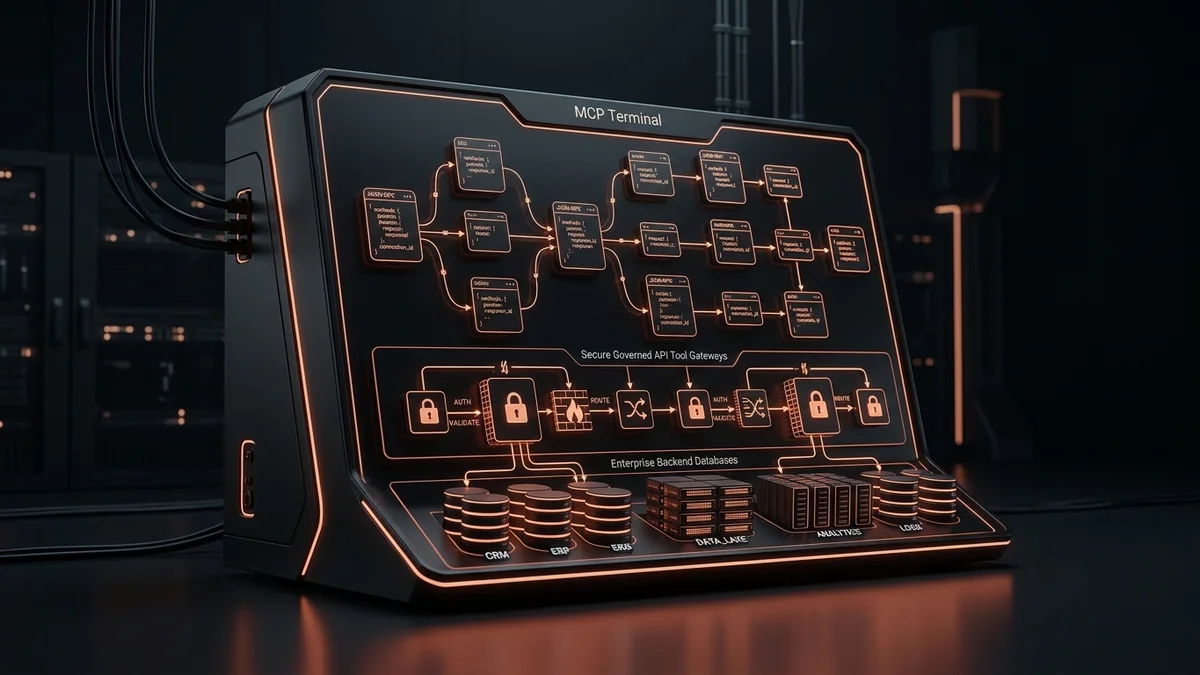
Custom MCP Server Development: Give AI Agents Real Business Access
Custom MCP Server Development connects Claude, ChatGPT, and Gemini to your actual business systems — securely, without duct-taped API hacks.

Portable AI Agent Skills: One Skill, Every Model
Stop rewriting the same AI agent workflow for Claude, Gemini, and Codex. Build portable skills once with AI Agent Workflow Automation and sync everywhere.

Software Engineer Career Roadmap
Explore the complete software engineer career roadmap. Master junior to senior transitions, high-demand tech specializations, and modern AI development.
Website SEO & AI Search Engines
Master website SEO & AI search engines. Automate instant IndexNow submissions to Bing and AI crawlers using GitHub Actions, curl, and automated sitemap.