
Software Engineering Fundamentals

Modern frameworks come and go, but the architectural principles underpinning relational databases, cloud microservices, and distributed consensus remain unchanged. Mastering software engineering fundamentals by studying seminal research papers bridges the gap between surface-level syntax and deep system design mastery.
Table of Contents
- Why Foundational Computer Science Papers Matter
- 4 Seminal Categories of Must-Read Papers
- Visualizing the Three-Pass Academic Reading Strategy
- Applying Historical Paradigms to Modern Cloud Architectures
- Frequently Asked Questions
- Conclusion & Next Steps
- Sources & Image Attributions
Why Foundational Computer Science Papers Matter
In an era dominated by rapid framework churn, software engineers often spend immense energy learning ephemeral APIs. However, true technical leverage comes from understanding the durable theoretical bedrock beneath modern tooling.
Studying software engineering fundamentals directly from original research publications provides three immense advantages:
- Uncovering Root Rationale: Understand why distributed systems experience split-brain scenarios or why relational databases separate queries from storage engines.
- Preventing Architectural Re-invention: Recognize that modern microservice challenges were analyzed decades ago in seminal modularity papers.
- Forecasting Industry Trends: Cutting-edge innovations—from transformer architectures to vector databases—are documented in academic literature years before commercialization.
Pairing classic computer science literature with practical patterns like Clean Architecture and personal development systems like an Engineering Work Logs System transforms developers into seasoned technical leaders.
4 Seminal Categories of Must-Read Papers
Here is a curated curriculum of high-impact computer science research papers categorized by domain:
1. Modular System Design & Managing Complexity
- On the Criteria To Be Used in Decomposing Systems into Modules (1972) — D.L. Parnas: Foundational text introducing information hiding and modular cohesion, shaping modern API and component design.
- Out of the Tar Pit (2006) — B. Moseley & P. Marks: Critical analysis of accidental vs. essential software complexity and how functional state management mitigates bugs.
2. Distributed Systems & Consensus
- Time, Clocks, and the Ordering of Events in Distributed Systems (1978) — Leslie Lamport: The foundational paper defining logical clocks and causal ordering in distributed networks.
- A Note on Distributed Computing (1994) — J. Waldo et al.: Explains why network latency, partial failure, and concurrency make transparent distributed object models fundamentally flawed.
3. Scalable Data Storage & Cloud Processing
- A Relational Model of Data for Large Shared Data Banks (1970) — E.F. Codd: Introduced relational algebra and normal forms, powering every SQL database in existence.
- Dynamo: Amazon’s Highly Available Key-value Store (2007) — G. DeCandia et al.: The design behind DynamoDB, demonstrating eventual consistency, consistent hashing, and vector clocks.
- The Google File System (2003) & MapReduce (2004): Seminal architectures that launched the big data revolution and Apache Hadoop.
4. Hardware, Caching & Performance
- What Every Programmer Should Know About Memory (2007) — Ulrich Drepper: In-depth guide to CPU caches (L1/L2/L3), memory prefetching, and bus saturation.

Visualizing the Three-Pass Academic Reading Strategy
Reading academic research does not require grinding through complex proofs on your first attempt. Utilize S. Keshav's proven three-pass methodology:
flowchart TD
    A["Pass 1 (5-10 min): Read Title, Abstract, Section Headers & Conclusion"] --> B{"Is Paper Relevant?"}
    B -->|No| C["Archive Paper / Move On"]
    B -->|Yes| D["Pass 2 (1 hour): Grasp Core Arguments & Note Key Figures (Skip Proofs)"]
D --> E["Pass 3 (1-3 hours): Mentally Re-implement & Challenge Assumptions"]Never read a computer science paper linearly from page one to the end. Scan the abstract and conclusion first to understand the core problem before investing time in implementation details.
Applying Historical Paradigms to Modern Cloud Architectures
Understanding historical trade-offs directly enhances day-to-day engineering decisions:
- CAP Theorem & Dynamo: Informs when to choose PostgreSQL strong consistency versus DynamoDB eventual consistency in high-traffic applications.
- Parnas Modularity: Dictates how to structure clean service boundaries within modern Laravel or Node.js applications.
- Memory Caching: Guides Redis cache-invalidation strategies and CPU-friendly loop optimization as explored in Web Application Performance Optimization.
Frequently Asked Questions
Where can I find free access to foundational computer science research?
Platforms like Papers We Love, arXiv.org, and university archives host free, open-access PDFs of nearly all seminal computer science papers.
How do I balance reading research papers with hands-on coding?
Dedicate one hour per week to reading a single paper during Friday learning blocks. Summarize your takeaways directly into your personal knowledge base or OmniVault AI The Developers Second Brain.
Are 1970s computer science papers still relevant to modern web developers?
Yes. The mathematical logic, database normal forms, and modular boundary principles established in the 1970s remain the foundation of every modern cloud platform and framework.
Conclusion & Next Steps
Frameworks evolve rapidly, but foundational engineering principles endure. By investing time into software engineering fundamentals, you develop the architectural depth required to design resilient, scalable digital systems.
At Masri Systems, we apply rigorous architectural standards and modern engineering practices to build high-performance software. Discover our custom Software Development and Clean Architecture solutions to see how we build enterprise-grade platforms.
Sources & Image Attributions
- Header Image: Historic university library and books by Giammarco Boscaro on Unsplash
- Body Image: Modern software engineering workspace by Caspar Camille Rubin on Unsplash
Follow Masri Systems on Google
Add us as a preferred source in Google Search.
Related Articles & Guides

Free Developer Certifications: 5 High-Impact Courses & Badges
5 verifiable free developer certifications and coding courses from Postman, Google Cloud, DeepLearning.AI, and freeCodeCamp to elevate your engineering resume.

Geschäftsprozesse automatisieren: 17 Scheduled Tasks der Agentur
Wie Masri Systems 17 autonome Agenten-Jobs, Sidecars und Cron-Tasks einsetzt, um Geschäftsprozesse im Entwickler-Alltag wartungsfrei zu automatisieren.

Sectors of Computer Science & Software Engineering
Explore the primary disciplines of computer science, tech career paths, software engineering specialization tracks, and modern developer tooling.

Software Engineer Career Roadmap
Explore the complete software engineer career roadmap. Master junior to senior transitions, high-demand tech specializations, and modern AI development.

Why PHP 8.4 & Laravel Are the Smartest Choice for Web Apps
Explore modern PHP web development. Discover why PHP 8.4 performance, strict typing, JIT compilation, and Laravel make PHP the top choice for software teams.
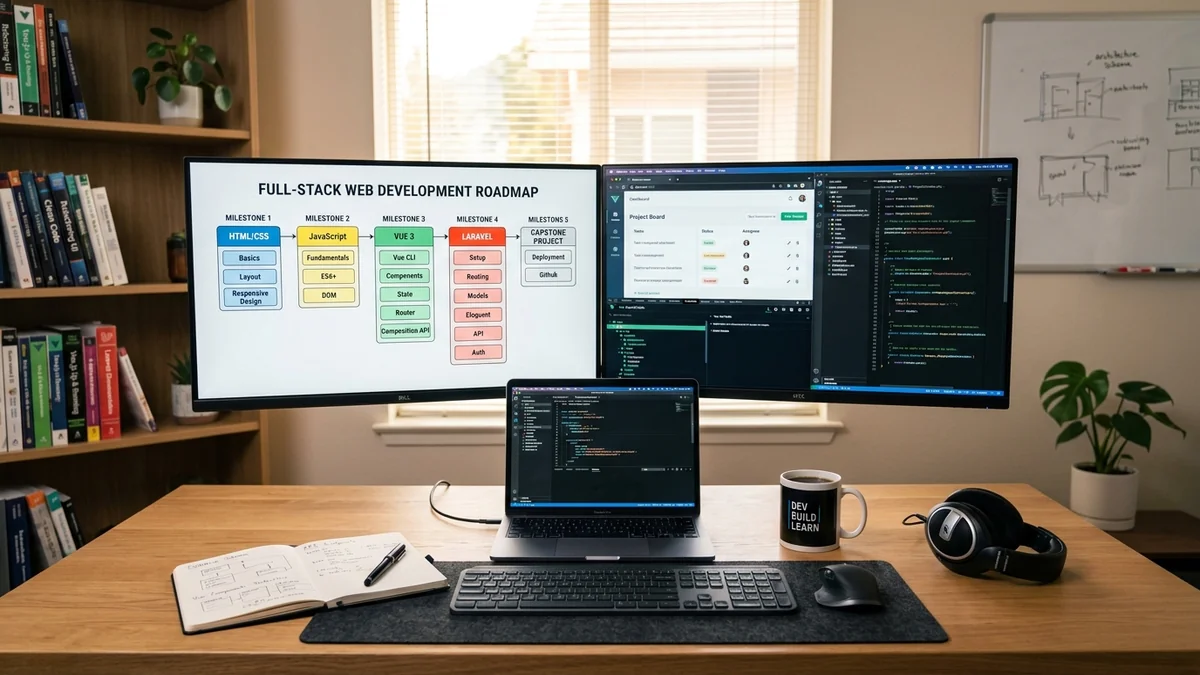
Web Development Curriculum: Full
Master full-stack web development. Comprehensive curriculum covering HTML/CSS/Tailwind, ES6+ JavaScript, Vue 3 & Vite, Laravel APIs, and CI/CD deployment.

Was ist eine Homepage Erklärung
Was ist eine Homepage Erklärung: Erfahren Sie den entscheidenden Unterschied zur Website, die 3 Kernaufgaben einer Startseite und den perfekten Seitenaufbau.

Vue JS Application Architecture
Master Vue JS application architecture. Comprehensive scaffolding guide covering TypeScript interfaces, modular directory structure, Pinia, and VueUse.