
Software Project Lifecycle Planning

Unstructured development schedules lead to scope creep and integration failures. Establishing rigorous Software Project Lifecycle Planning breaks complex software applications into numbered hierarchical milestones, pairs every task with automated feature test criteria, and creates deterministic execution gates for human engineers and autonomous AI agents alike.
Table of Contents
- The Importance of Phased Engineering Roadmaps
- 4 Core Phases of Modern Software Project Lifecycle Planning
- Visualizing the Phased Project Delivery Funnel
- Defining Strict Acceptance Criteria & Automated Test Specs
- Frequently Asked Questions
- Conclusion & Next Steps
- Sources & Image Attributions
The Importance of Phased Engineering Roadmaps
Software projects rarely fail due to bad syntax; they fail due to ambiguous project boundaries, unsequenced database dependencies, and lack of objective completion criteria. When building complex web applications, attempting to construct UI components before finalizing data contracts results in cascading refactors.
Adopting structured Software Project Lifecycle Planning establishes clarity. By decomposing product requirements into numbered phases (e.g., Phase 1.0 Foundation, Phase 2.1 API Routing), technical leads create clear, actionable roadmaps that both engineering teams and autonomous coding agents can execute deterministically.
Pairing structured phase planning with foundational engineering paradigms like Clean Architecture and personal productivity habits from Apply the 80-20 Principle for Productivity ensures timely delivery within budget constraints.
4 Core Phases of Modern Software Project Lifecycle Planning
A robust software delivery lifecycle moves systematically through four sequential phases:
Phase 1: Architectural Foundation & Data Modeling
- Key Focus: Defining database schemas, foreign key relationships, migrations, and seeding scripts.
- Verification Gate: Passing schema integrity tests and automated database factory seeding.
Phase 2: Domain Logic & Core Business APIs
- Key Focus: Implementing repository interfaces, domain services, and single-action controllers.
- Verification Gate: 100% unit test coverage over business calculations and domain invariants.
Phase 3: Presentation Layer & User Workflows
- Key Focus: Constructing responsive frontend interfaces, Inertia/Vue components, and form validation.
- Verification Gate: End-to-end browser tests verifying complete user sign-up and checkout journeys.
Phase 4: Observability, Security & Production Deployment
- Key Focus: Integrating error telemetry, setting up background queue workers (Redis), and configuring CI/CD pipelines.
- Verification Gate: Automated load tests, security audits, and zero-downtime staging deployment.

Visualizing the Phased Project Delivery Funnel
Progressing through structured delivery gates ensures stable software release cycles:
flowchart TD
    A["Phase 1: Architecture & Data Schema Specs"] --> B["Phase 2: Core Domain Logic & API Contracts"]
    B --> C["Phase 3: Frontend UI & Interactive Workflows"]
    C --> D["Phase 4: Security, Telemetry & Deployment"]
    B -->|Schema Change Needed| A
    C -->|API Contract Update| B
D --> E["Verified Production Release"]Use hierarchical numbering (Phase 1.1, Phase 1.2) for every task and sub-task. Clear task IDs allow AI agents to reference and track completed milestones across long-running development sessions without losing state.
Defining Strict Acceptance Criteria & Automated Test Specs
To ensure high engineering velocity, every task in the project backlog must contain explicit acceptance criteria:
- Given/When/Then Format: Define preconditions, user actions, and expected database states.
- Automated Feature Tests: Pair each user story with a concrete Pest or Jest feature test specification.
- Continuous Backlog Synchronization: Update master planning documents as tasks are completed to maintain team-wide visibility.
Frequently Asked Questions
How does phased planning benefit AI coding agents?
AI agents require clear, bite-sized task definitions with verifiable test criteria. Phased roadmaps prevent agents from attempting too much at once and hallucinating non-existent dependencies.
What is the ideal sprint duration for phased software planning?
Modern teams utilize two-week sprint cycles, breaking larger phases into discrete sub-phase deliverables that can be deployed to staging at the end of each sprint.
When should automated feature tests be written?
Feature tests should be specified during Phase 1 alongside database schemas and user stories, following Test-Driven Development (TDD) principles before implementing presentation components.
Conclusion & Next Steps
Disciplined Software Project Lifecycle Planning transforms chaotic development backlogs into predictable, high-velocity engineering pipelines. By defining clear milestones and automated verification gates, software teams build scalable digital products with confidence.
At Masri Systems, we architect high-performance digital platforms and manage enterprise software implementations. Explore our tailored Software Development and Website Design solutions to discover how we deliver complex software projects on time and within budget.
Sources & Image Attributions
- Header Image: Software architecture planning by UX Indonesia on Unsplash
- Body Image: Team collaborating on software architecture by Annie Spratt on Unsplash
Follow Masri Systems on Google
Add us as a preferred source in Google Search.
Related Articles & Guides

AI Agent Workflow Automation: Curated 123-Tool Stack
Curated directory of 123 open-source AI agent frameworks, MCP servers, and developer tools for production AI agent workflow automation and autonomous systems.

Free Developer Certifications: 5 High-Impact Courses & Badges
5 verifiable free developer certifications and coding courses from Postman, Google Cloud, DeepLearning.AI, and freeCodeCamp to elevate your engineering resume.

Geschäftsprozesse automatisieren: 17 Scheduled Tasks der Agentur
Wie Masri Systems 17 autonome Agenten-Jobs, Sidecars und Cron-Tasks einsetzt, um Geschäftsprozesse im Entwickler-Alltag wartungsfrei zu automatisieren.

Command Center: Autonome KI Agenten Geschäftsprozesse KMU steuern
Autonome KI Agenten Geschäftsprozesse KMU: Steuern Sie Gemini, Codex und Claude parallel in einem sicheren VILT Stack Command Center mit OS-Locking.

Sectors of Computer Science & Software Engineering
Explore the primary disciplines of computer science, tech career paths, software engineering specialization tracks, and modern developer tooling.
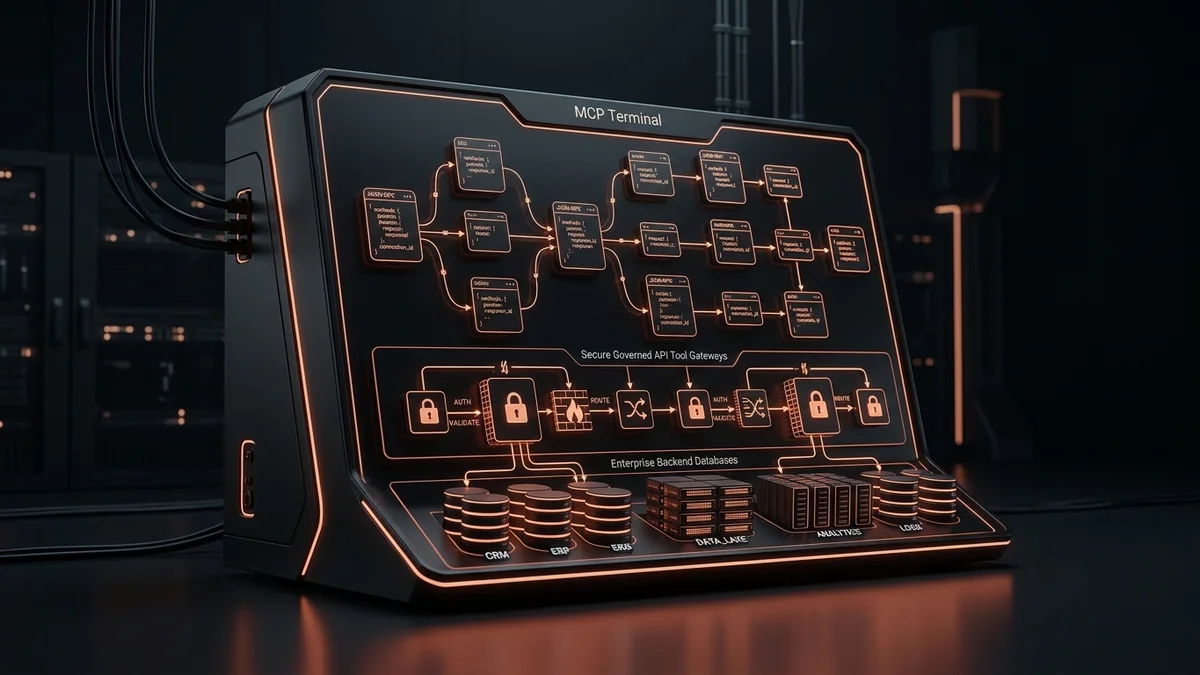
Custom MCP Server Development: Give AI Agents Real Business Access
Custom MCP Server Development connects Claude, ChatGPT, and Gemini to your actual business systems — securely, without duct-taped API hacks.

Portable AI Agent Skills: One Skill, Every Model
Stop rewriting the same AI agent workflow for Claude, Gemini, and Codex. Build portable skills once with AI Agent Workflow Automation and sync everywhere.

Software Engineer Career Roadmap
Explore the complete software engineer career roadmap. Master junior to senior transitions, high-demand tech specializations, and modern AI development.