
AI Software Development Impact

Software engineering has evolved from manual coding assistance to complete lifecycle automation. The AI Software Development Impact in 2026 spans every phase of the SDLC—transforming developers into systems orchestrators, establishing self-healing staging environments, and eliminating manual pull request friction across engineering organizations.
Table of Contents
- The Architectural Re-Engineering of the SDLC
- 4 Core SDLC Transformations Powered by AI Agents
- Visualizing the Agentic Software Lifecycle
- Multi-Agent Collaboration & DevSecOps Gatekeeping
- Frequently Asked Questions
- Conclusion & Next Steps
- Sources & Image Attributions
The Architectural Re-Engineering of the SDLC
In previous years, AI in software development was treated as an enhanced text editor feature. Developers prompted language models for single functions or regex patterns, then manually copied results into local repositories.
In 2026, the AI Software Development Impact reaches the entire Software Development Lifecycle (SDLC). Autonomous agent networks analyze product requirements, generate database migrations, construct frontend components, execute automated regression suites, and manage canary deployments.
Pairing automated agent pipelines with robust architectural foundations like Clean Architecture and personal productivity vaults like OmniVault AI The Developers Second Brain enables engineering teams to ship features with unprecedented speed and resilience.
4 Core SDLC Transformations Powered by AI Agents
The modern development lifecycle is restructured around four automated pillars:
1. Specification-Driven Planning & Scaffolding
Product managers and lead engineers author detailed RFCs and user story specifications. Agents analyze these documents, synthesize architecture diagrams, and generate complete project scaffolding with zero manual boilerplate.
2. Autonomous Refactoring & Technical Debt Elimination
Instead of scheduling quarterly refactoring sprints, background agents continuously scan repositories, identifying deprecated API calls, resolving N+1 database queries, and upgrading dependency versions autonomously.
3. Self-Healing Staging & CI/CD Pipelines
When a build breaks or an automated integration test fails, DevOps agents analyze runtime logs, locate the offending commit, generate a patch, and verify the fix in staging before alerting human engineers.
4. Continuous Multi-Agent Security Auditing
Dedicated security agents cross-reference code changes against global vulnerability registries, ensuring strict input validation, cryptographic integrity, and OWASP LLM compliance.

Visualizing the Agentic Software Lifecycle
The modern SDLC operates as a continuous, self-correcting engineering feedback loop:
flowchart TD
    A["Human Defines Business Objectives & RFC"] --> B["Planning Agent Synthesizes Architecture"]
    B --> C["Coding Agent Scaffolds & Implements Code"]
    C --> D["Testing Agent Runs Unit & Regression Suites"]
    D -->|Tests Fail| E["Self-Healing Refactoring Loop"]
    E --> C
    D -->|Tests Pass| F["Automated AI Security & Style Review"]
    F --> G["Staging Deployment & Telemetry Verification"]
G --> H["Human Sign-Off & Production Rollout"]Developers must transition from solo instrumentalists to orchestra conductors. Focus your cognitive energy on system design, security boundaries, and domain logic while delegating mechanical implementation to specialized agents.
Multi-Agent Collaboration & DevSecOps Gatekeeping
Scaling agentic development requires robust security governance:
- Least-Privilege Tool Execution: Sandbox agent execution environments to ensure tools cannot execute destructive database operations without human authorization.
- Mandatory Human Sign-Off: Establish hard approval gates for any code changes touching core authentication, payments, or production data stores.
- Automated Regression Testing: Pair agent pull requests with comprehensive test suites to guarantee downstream API contracts remain intact.
Frequently Asked Questions
Has AI replaced software engineers in 2026?
No. AI has automated repetitive syntax generation and boilerplate tasks, elevating software engineers into higher-value systems architects, domain specialists, and product strategists.
What is the difference between an AI assistant and an AI agent?
An AI assistant provides passive suggestions based on immediate editor context. An AI agent operates with goal-oriented autonomy—planning, executing, testing, and self-correcting across multi-file repositories.
How does agentic development affect software security?
Dedicated security agents continuously audit pull requests for injection vulnerabilities, hallucinated dependencies, and misconfigured permissions, resulting in more secure production releases.
Conclusion & Next Steps
Understanding the broader AI Software Development Impact allows engineering teams to modernize their development workflows. By orchestrating intelligent agents and enforcing automated quality gates, organizations build resilient, high-performance software.
At Masri Systems, we architect high-performance digital platforms, custom backends, and automated developer systems. Explore our specialized Software Development and Website Architecture solutions to scale your technical infrastructure.
Sources & Image Attributions
- Header Image: Developer working on code review by Caspar Camille Rubin on Unsplash
- Body Image: Futuristic technology room by Taylor Vick on Unsplash
Follow Masri Systems on Google
Add us as a preferred source in Google Search.
Related Articles & Guides
AI Agent Workflow Automation: Curated 123-Tool Stack
Curated directory of 123 open-source AI agent frameworks, MCP servers, and developer tools for production AI agent workflow automation and autonomous systems.
Free Developer Certifications: 5 High-Impact Courses & Badges
5 verifiable free developer certifications and coding courses from Postman, Google Cloud, DeepLearning.AI, and freeCodeCamp to elevate your engineering resume.
Geschäftsprozesse automatisieren: 17 Scheduled Tasks der Agentur
Wie Masri Systems 17 autonome Agenten-Jobs, Sidecars und Cron-Tasks einsetzt, um Geschäftsprozesse im Entwickler-Alltag wartungsfrei zu automatisieren.
Command Center: Autonome KI Agenten Geschäftsprozesse KMU steuern
Autonome KI Agenten Geschäftsprozesse KMU: Steuern Sie Gemini, Codex und Claude parallel in einem sicheren VILT Stack Command Center mit OS-Locking.

Sectors of Computer Science & Software Engineering
Explore the primary disciplines of computer science, tech career paths, software engineering specialization tracks, and modern developer tooling.
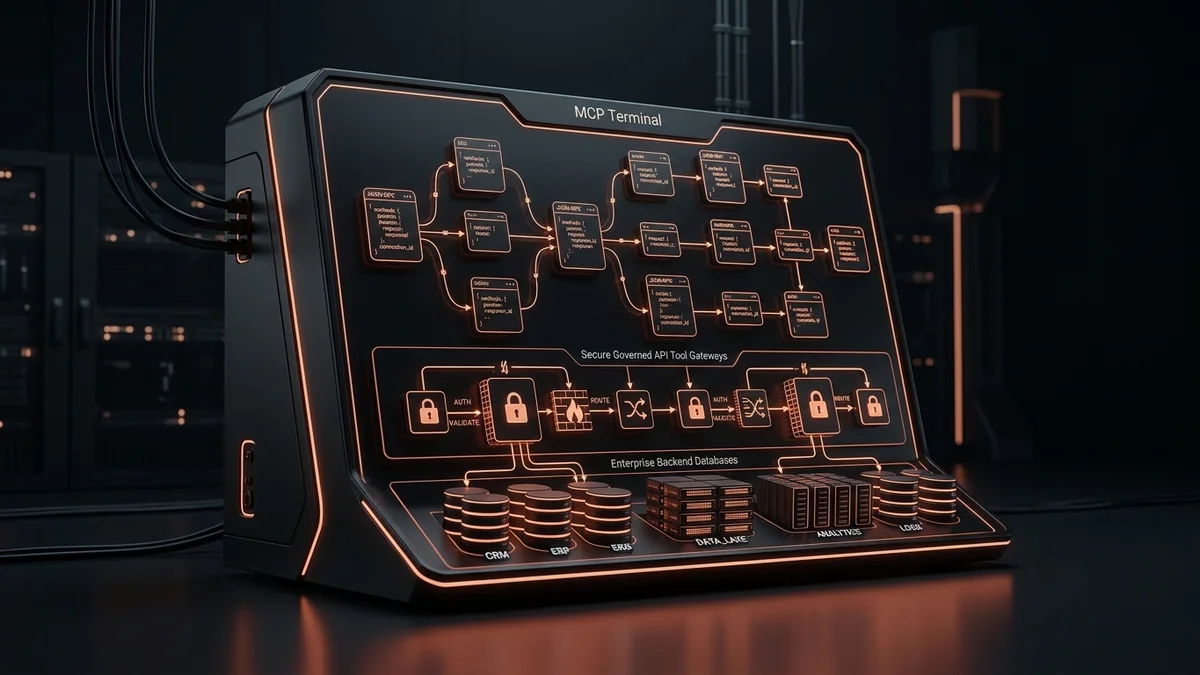
Custom MCP Server Development: Give AI Agents Real Business Access
Custom MCP Server Development connects Claude, ChatGPT, and Gemini to your actual business systems — securely, without duct-taped API hacks.

Portable AI Agent Skills: One Skill, Every Model
Stop rewriting the same AI agent workflow for Claude, Gemini, and Codex. Build portable skills once with AI Agent Workflow Automation and sync everywhere.

Openship: A Self-Hosted Deployment Platform With No CI/CD Pipeline
Openship is an Apache 2.0 self-hosted deployment platform that skips CI/CD YAML. What v0.6.7 does well, and why pre-1.0 status should shape your rollout.