
Architectural Paradigms & Frontier Model Evolution in 2026
Traditional software engineering uses deterministic Software Development Kits (SDKs) to execute rigid rules. In contrast, an Agent Development Kit vs SDK comparison reveals that ADKs manage probabilistic AI reasoning, stateful memory retrieval (RAG), and sandboxed tool execution, transforming raw LLMs into reliable autonomous systems.
Table of Contents
- Determinism vs. Autonomy: The Builder's Dilemma
- 4 Core Primitives of an Agent Development Kit (ADK)
- Visualizing the SDK vs. ADK Architectural Stack
- The Frontier Model Landscape in 2026
- Frequently Asked Questions
- Conclusion & Next Steps
- Sources & Image Attributions
Determinism vs. Autonomy: The Builder's Dilemma
When software engineers build traditional applications, they rely on SDKs. SDKs provide static classes, typed compilers, and deterministic API clients. If you pass parameter $A$ to function $B$, you obtain result $C$ every single time.
However, building autonomous AI systems requires handling probabilistic outputs. Language models predict token probabilities rather than following hardcoded logic. Evaluating an Agent Development Kit vs SDK highlights the need for specialized ADK abstractions that wrap probabilistic models inside deterministic operational harnesses.
Pairing structured ADK primitives with clean architectural boundaries from Clean Architecture and personal knowledge vaults from OmniVault AI The Developers Second Brain enables developers to build self-healing, agentic software platforms.
4 Core Primitives of an Agent Development Kit (ADK)
An ADK provides specialized building blocks designed specifically for managing probabilistic AI behavior:
1. Dynamic Memory & State Management
ADKs manage short-term working context, conversation history, and long-term vector embeddings (RAG) to ensure agents maintain factual consistency over extended multi-step tasks.
2. Guardrailed Tool Calling & Schema Routing
ADKs translate natural language intent into typed JSON schemas, routing function calls to local file systems, databases, or terminal environments within strict execution sandboxes.
3. Self-Correction & Reasoning Loops
When an agent encounters a compiler error or schema mismatch, an ADK enables automated reflection loops—allowing the model to inspect terminal logs, diagnose the fault, and retry with an amended patch.
4. Deterministic Output Parsing & Validation
ADKs enforce strict Pydantic or TypeScript schema validation, guaranteeing that model responses conform to expected application data structures.

Visualizing the SDK vs. ADK Architectural Stack
The division of labor between deterministic application code and probabilistic AI orchestration is clearly separated:
flowchart TD
    subgraph "Deterministic Application Layer (SDK)"
        A["UI / Database / Network Routing"]
        B["Business Rules & Static Logic"]
    end
    subgraph "Probabilistic Agent Layer (ADK)"
        C["Agentic Harness & Orchestrator"]
        D["Memory Retrieval & Semantic Search"]
        E["Reasoning Loops & Self-Correction"]
        F["Sandboxed Tool Router (MCP)"]
    end

    A --> C
    B --> C
    C --> D
    C --> E
    C --> F
F -->|Executes Tool| AAlways execute agent tool calls through an ADK permission gate. Never grant autonomous models direct unmonitored access to write permissions on production databases or destructive CLI commands.
The Frontier Model Landscape in 2026
An ADK is only as capable as the underlying frontier model it orchestrates. In 2026, the model ecosystem has matured significantly:
- Gemini 3.1 Pro: The industry workhorse for agentic coding, featuring massive token context windows, extreme token efficiency, and advanced reasoning over multi-file repositories.
- Mid-Cycle Model Iterations: Frontier model providers continuously retrain base architectures to enhance multi-step tool-calling reliability and eliminate edge-case hallucinations.
- Model Context Protocol (MCP) Integration: Standardizing how ADKs connect to external tools ensures developers avoid lock-in to any single proprietary LLM provider.
Frequently Asked Questions
What is the primary difference between an SDK and an ADK?
An SDK provides tools to build traditional, deterministic software applications. An ADK provides primitives (memory, tool routing, self-correction) to manage probabilistic, autonomous AI agents.
Can an ADK replace an SDK entirely?
No. Developers use SDKs to build foundational application infrastructure (databases, APIs, web interfaces) and ADKs to build the intelligent agents operating within that software.
How do ADKs prevent AI models from spinning into infinite loops?
ADKs enforce configurable execution budgets, maximum retry counts, and timeout thresholds, automatically halting agent tasks if reasoning loops fail to converge.
Conclusion & Next Steps
Understanding the architectural distinction in the Agent Development Kit vs SDK landscape is essential for modern technical leaders. By leveraging ADKs to manage probabilistic intelligence, engineering teams build robust, autonomous software systems.
At Masri Systems, we architect high-performance digital systems, custom backends, and agentic workflows. Explore our specialized Software Development and Website Architecture services to build future-ready software platforms.
Sources & Image Attributions
- Header Image: Developer working on code review by Caspar Camille Rubin on Unsplash
- Body Image: Abstract AI neural network by Alina Grubnyak on Unsplash
Follow Masri Systems on Google
Add us as a preferred source in Google Search.
Related Articles & Guides
AI Agent Workflow Automation: Curated 123-Tool Stack
Curated directory of 123 open-source AI agent frameworks, MCP servers, and developer tools for production AI agent workflow automation and autonomous systems.

Geschäftsprozesse automatisieren: 17 Scheduled Tasks der Agentur
Wie Masri Systems 17 autonome Agenten-Jobs, Sidecars und Cron-Tasks einsetzt, um Geschäftsprozesse im Entwickler-Alltag wartungsfrei zu automatisieren.
Command Center: Autonome KI Agenten Geschäftsprozesse KMU steuern
Autonome KI Agenten Geschäftsprozesse KMU: Steuern Sie Gemini, Codex und Claude parallel in einem sicheren VILT Stack Command Center mit OS-Locking.

Sectors of Computer Science & Software Engineering
Explore the primary disciplines of computer science, tech career paths, software engineering specialization tracks, and modern developer tooling.
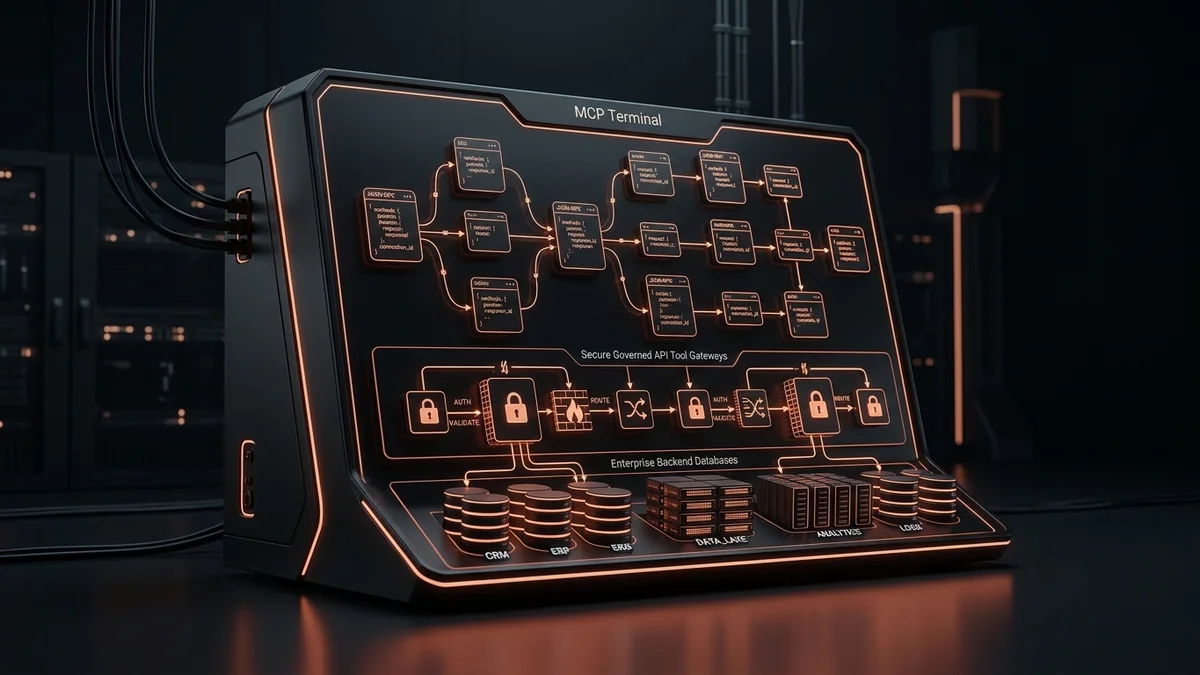
Custom MCP Server Development: Give AI Agents Real Business Access
Custom MCP Server Development connects Claude, ChatGPT, and Gemini to your actual business systems — securely, without duct-taped API hacks.

Portable AI Agent Skills: One Skill, Every Model
Stop rewriting the same AI agent workflow for Claude, Gemini, and Codex. Build portable skills once with AI Agent Workflow Automation and sync everywhere.

Software Engineer Career Roadmap
Explore the complete software engineer career roadmap. Master junior to senior transitions, high-demand tech specializations, and modern AI development.
Website SEO & AI Search Engines
Master website SEO & AI search engines. Automate instant IndexNow submissions to Bing and AI crawlers using GitHub Actions, curl, and automated sitemap.