
Harnesses, SDKs & Agent Development Kits (ADKs)

Scaling autonomous software development requires moving beyond isolated prompts toward structured multi-agent coordination. Implementing an AI Agent Swarms Architecture combines probabilistic Agent Development Kits (ADKs) with deterministic Agentic Harnesses, enabling specialized worker agents to collaborate reliably across complex enterprise codebases.
Table of Contents
- The Architecture Dilemma: Deterministic vs. Probabilistic Systems
- 3 Core Architectural Layers of Agentic Systems
- SDK vs. ADK: Choosing the Right Developer Primitives
- Visualizing the Multi-Agent Swarm Ecosystem
- Sandbox Isolation & Security Guardrails
- Frequently Asked Questions
- Conclusion & Next Steps
- Sources & Image Attributions
The Architecture Dilemma: Deterministic vs. Probabilistic Systems
Traditional software engineering relies on deterministic Software Development Kits (SDKs) where every input maps predictably to a specific output. However, modern AI systems are probabilistic—language models generate varying token sequences based on context and temperature.
Bridging this gap requires an AI Agent Swarms Architecture. By wrapping raw language models inside structured operational harnesses and delegating tasks across specialized sub-agents, engineering teams build systems that exhibit both creative autonomy and enterprise reliability.
Pairing multi-agent architectures with robust patterns like Clean Architecture and automated validation via Automated AI Code Review ensures scalable development without uncontrolled agent drift.
3 Core Architectural Layers of Agentic Systems
Production-grade agentic platforms structure their runtime into three distinct layers:
1. The Agentic Swarm (Collaborative Network)
An agent swarm is a network of specialized agents working in parallel under a central orchestrator. Rather than packing all system requirements into one massive prompt, tasks are distributed: a security agent scans dependencies, a backend agent generates endpoints, and a testing agent verifies test suites.
2. The Agentic Harness (Operational Control Plane)
The harness is the deterministic software wrapper surrounding the AI model. It manages short-term and long-term memory (RAG), handles state persistence, throttles API rate limits, and enforces sandboxed tool execution.
3. Agent Development Kits (ADKs)
Unlike traditional SDKs that provide static API wrappers, an ADK provides specialized primitives for prompt versioning, structured output parsing, semantic memory retrieval, and multi-step reasoning loops.

SDK vs. ADK: Choosing the Right Developer Primitives
Understanding when to utilize deterministic SDKs versus probabilistic ADKs is essential for technical architects:
| Dimension | Software Development Kit (SDK) | Agent Development Kit (ADK) |
|---|---|---|
| Execution Model | Deterministic, rule-based | Probabilistic, reasoning-driven |
| Core Primitives | Compilers, API clients, classes | Memory stores, tool routers, prompt graphs |
| Primary Use Case | Building base application infrastructure | Building autonomous, self-correcting agents |
| Error Handling | Static try/catch exception blocks | Dynamic self-reflection and retry loops |
Visualizing the Multi-Agent Swarm Ecosystem
Information and control flow smoothly between deterministic infrastructure and probabilistic agent nodes:
flowchart TD
    A["User Objective / System RFC"] --> B["Agentic Harness & Orchestrator"]
    B --> C["ADK Memory & Context Store (RAG)"]
    B --> D["Worker Agent 1 (Schema & DB)"]
    B --> E["Worker Agent 2 (API & Controllers)"]
    B --> F["Worker Agent 3 (QA & Testing)"]
    D --> G["Sandboxed Tool Execution (Terminal / DB / Git)"]
    E --> G
    F --> G
    G --> H["Deterministic CI/CD Verification"]
H --> I["Production Deployment"]Always execute agent terminal commands within containerized sandboxes. Never grant autonomous agents unconstrained root permissions on host development machines or live production databases.
Sandbox Isolation & Security Guardrails
Running autonomous swarms requires robust security isolation:
- Ephemeral Containerization: Spin up isolated Docker containers or Git worktrees for every agent task run.
- Strict Role-Based Tooling: Provide agents with only the minimal CLI tools necessary for their specific domain.
- Model-Agnostic Routing: Architect harnesses using the Model Context Protocol (MCP) to allow dynamic switching between cloud LLMs and local models.
Frequently Asked Questions
What is the primary role of an Agentic Harness?
The harness provides the deterministic boundaries—memory persistence, tool permission gates, rate limiting, and error recovery—that allow probabilistic AI models to function reliably.
Can an Agentic Swarm operate with local AI models?
Yes. By using model-agnostic harnesses and local execution runtimes (like Ollama or vLLM), swarms can execute tasks entirely offline without sending proprietary data to external cloud providers.
How does an ADK improve upon standard LLM API calls?
An ADK provides pre-built abstractions for multi-step reasoning, conversation state serialization, vector search integration, and structured JSON validation.
Conclusion & Next Steps
Adopting an AI Agent Swarms Architecture allows engineering teams to coordinate autonomous systems at enterprise scale. By pairing deterministic harnesses with flexible ADK primitives, organizations unlock unprecedented development velocity.
At Masri Systems, we architect distributed software systems, custom enterprise backends, and agentic workflows. Explore our specialized Software Development and Website Architecture services to build future-ready software platforms.
Sources & Image Attributions
- Header Image: Abstract technology lines by NASA on Unsplash
- Body Image: Developer working on code review by Caspar Camille Rubin on Unsplash
Follow Masri Systems on Google
Add us as a preferred source in Google Search.
Related Articles & Guides
AI Agent Workflow Automation: Curated 123-Tool Stack
Curated directory of 123 open-source AI agent frameworks, MCP servers, and developer tools for production AI agent workflow automation and autonomous systems.

Geschäftsprozesse automatisieren: 17 Scheduled Tasks der Agentur
Wie Masri Systems 17 autonome Agenten-Jobs, Sidecars und Cron-Tasks einsetzt, um Geschäftsprozesse im Entwickler-Alltag wartungsfrei zu automatisieren.
Command Center: Autonome KI Agenten Geschäftsprozesse KMU steuern
Autonome KI Agenten Geschäftsprozesse KMU: Steuern Sie Gemini, Codex und Claude parallel in einem sicheren VILT Stack Command Center mit OS-Locking.

Sectors of Computer Science & Software Engineering
Explore the primary disciplines of computer science, tech career paths, software engineering specialization tracks, and modern developer tooling.
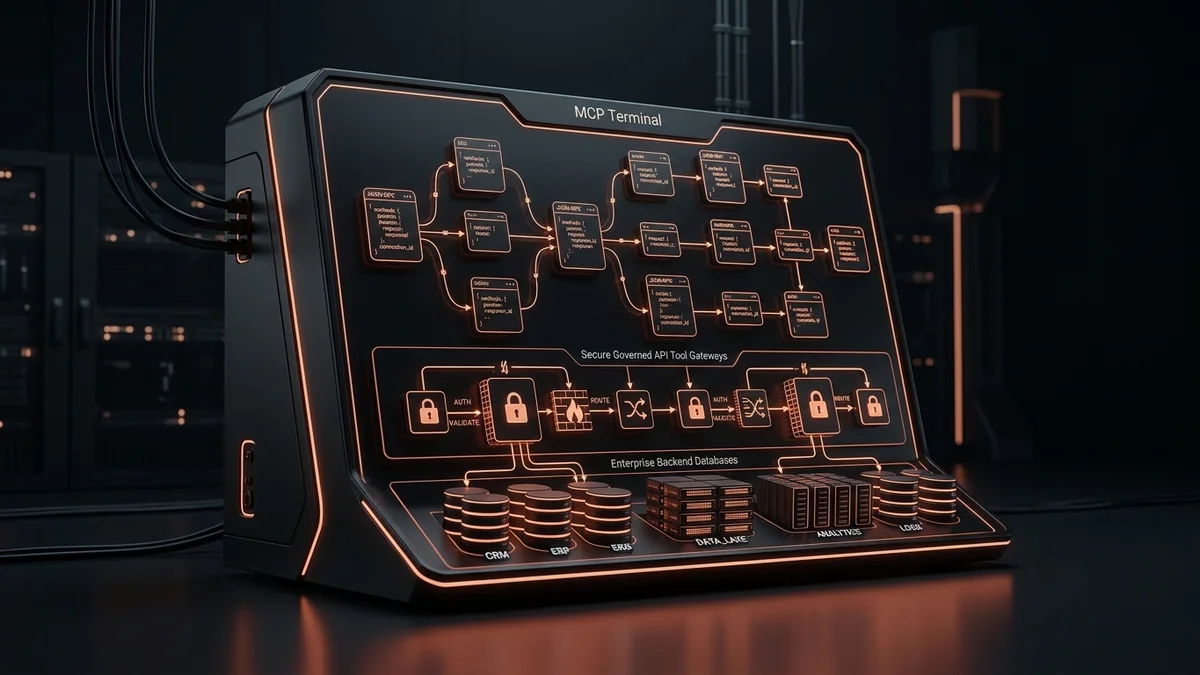
Custom MCP Server Development: Give AI Agents Real Business Access
Custom MCP Server Development connects Claude, ChatGPT, and Gemini to your actual business systems — securely, without duct-taped API hacks.

Portable AI Agent Skills: One Skill, Every Model
Stop rewriting the same AI agent workflow for Claude, Gemini, and Codex. Build portable skills once with AI Agent Workflow Automation and sync everywhere.

Software Engineer Career Roadmap
Explore the complete software engineer career roadmap. Master junior to senior transitions, high-demand tech specializations, and modern AI development.
Website SEO & AI Search Engines
Master website SEO & AI search engines. Automate instant IndexNow submissions to Bing and AI crawlers using GitHub Actions, curl, and automated sitemap.