
The Complete Engineering Guide to Systems, Databases & DevOps
Backend software engineering is the core operational engine powering modern digital applications. Following a comprehensive Backend Development Roadmap guides developers through network fundamentals, relational database modeling, REST & GraphQL API design, and containerized DevOps deployment, building scalable server architectures.
Table of Contents
- The Scope of Modern Backend Engineering
- 6 Core Milestones of the Backend Development Roadmap
- Visualizing the Backend System Architecture
- Scaling Databases, Caching & Asynchronous Queues
- Frequently Asked Questions
- Conclusion & Next Steps
- Sources & Image Attributions
The Scope of Modern Backend Engineering
While frontend engineering focuses on visual hierarchy and reactive interfaces, backend engineering handles the vital mechanics: data persistence, transaction safety, business logic orchestration, security authentication, and distributed computing.
Navigating this domain without a Backend Development Roadmap leads to fragmented learning. By systematically progressing through core networking, database modeling, and server-side frameworks, developers acquire the architectural intuition needed to build resilient enterprise systems.
Pairing backend mastery with foundational patterns like Clean Architecture and personal productivity vaults like OmniVault AI The Developers Second Brain guarantees consistent engineering growth.
6 Core Milestones of the Backend Development Roadmap
A production-ready backend engineering education encompasses six key domains:
1. Networking & Web Fundamentals
Understanding the HTTP/HTTPS request-response lifecycle, DNS resolution, TLS encryption handshakes, and TCP/IP transport layers.
2. Primary Server-Side Language Mastery
Deep specialization in a modern backend language: PHP (Laravel), TypeScript (Node.js), Go, or Python, mastering concurrency models and strict typing.
3. Relational & NoSQL Database Architecture
Designing normalized relational schemas (PostgreSQL, MySQL), utilizing transactions (ACID), indexing hot columns, and leveraging document/key-value stores (Redis, MongoDB) for high-speed caching.
4. API Design & Security Authentication
Building clean RESTful APIs and GraphQL schemas secured via OAuth 2.0, JWT, and Passkey/WebAuthn protocols with strict rate-limiting.
5. Asynchronous Workflows & Message Queues
Decoupling latency-heavy operations (PDF rendering, email cascades, payment webhooks) into background Redis workers and event queues.
6. Containerization, CI/CD & Cloud DevOps
Packaging applications in Docker containers, writing automated GitHub Actions test pipelines, and deploying to cloud infrastructure (Hetzner, AWS).

Visualizing the Backend System Architecture
Information moves through a multi-tiered server architecture to ensure data integrity and sub-second response times:
flowchart TD
    A["Client Request (Web / Mobile / Webhook)"] --> B["Reverse Proxy & Load Balancer (Nginx / Cloudflare)"]
    B --> C["Backend Application Server (Laravel / Go / Node)"]
    C --> D{"Cache Layer (Redis)"}
    D -->|Cache Hit| B
    D -->|Cache Miss| E["Primary Relational DB (PostgreSQL)"]
    C --> F["Async Message Queue (Redis / SQS)"]
F --> G["Background Queue Workers (Emails / Webhooks)"]Never store session state or file uploads on the local web server disk. Offloading sessions to Redis and media to object storage (S3) allows your application servers to scale horizontally with zero downtime.
Scaling Databases, Caching & Asynchronous Queues
As traffic grows, backend bottlenecks almost always originate in data layers:
- Eager Loading: Eliminate N+1 query patterns as detailed in our guide on Web Application Performance Optimization.
- Read Replicas: Distribute heavy read traffic across replica databases while directing writes to a primary database instance.
- Connection Pooling: Use connection poolers like PgBouncer to prevent high concurrency spikes from exhausting database connections.
Frequently Asked Questions
Which backend language should beginners learn first in 2026?
PHP (with Laravel) and TypeScript (with Node.js) provide the fastest path to building production-ready applications, offering comprehensive ecosystems, extensive documentation, and strong enterprise job demand.
Is SQL still relevant compared to NoSQL databases?
Yes. Over 85% of commercial enterprise applications rely on relational SQL databases (like PostgreSQL) because ACID compliance and relational integrity are essential for financial and user data.
What is the role of DevOps in backend engineering?
DevOps bridges the gap between writing code and running it in production, automating continuous integration testing, containerized deployments, and server health monitoring.
Conclusion & Next Steps
Following a structured Backend Development Roadmap equips software engineers with the durable skills required to architect enterprise-grade digital systems. By mastering databases, API contracts, and queue architectures, you build resilient digital infrastructure that scales smoothly.
At Masri Systems, we architect robust software backends, high-performance web platforms, and automated cloud systems. Explore our specialized Software Development and Website Architecture services to learn how we build scalable digital solutions for modern enterprises.
Sources & Image Attributions
- Header Image: Server room computing racks by Jordan Harrison on Unsplash
- Body Image: Developer working on backend code by Caspar Camille Rubin on Unsplash
Follow Masri Systems on Google
Add us as a preferred source in Google Search.
Related Articles & Guides

Free Developer Certifications: 5 High-Impact Courses & Badges
5 verifiable free developer certifications and coding courses from Postman, Google Cloud, DeepLearning.AI, and freeCodeCamp to elevate your engineering resume.

Geschäftsprozesse automatisieren: 17 Scheduled Tasks der Agentur
Wie Masri Systems 17 autonome Agenten-Jobs, Sidecars und Cron-Tasks einsetzt, um Geschäftsprozesse im Entwickler-Alltag wartungsfrei zu automatisieren.

Sectors of Computer Science & Software Engineering
Explore the primary disciplines of computer science, tech career paths, software engineering specialization tracks, and modern developer tooling.

Openship: A Self-Hosted Deployment Platform With No CI/CD Pipeline
Openship is an Apache 2.0 self-hosted deployment platform that skips CI/CD YAML. What v0.6.7 does well, and why pre-1.0 status should shape your rollout.

Software Engineer Career Roadmap
Explore the complete software engineer career roadmap. Master junior to senior transitions, high-demand tech specializations, and modern AI development.

Why PHP 8.4 & Laravel Are the Smartest Choice for Web Apps
Explore modern PHP web development. Discover why PHP 8.4 performance, strict typing, JIT compilation, and Laravel make PHP the top choice for software teams.
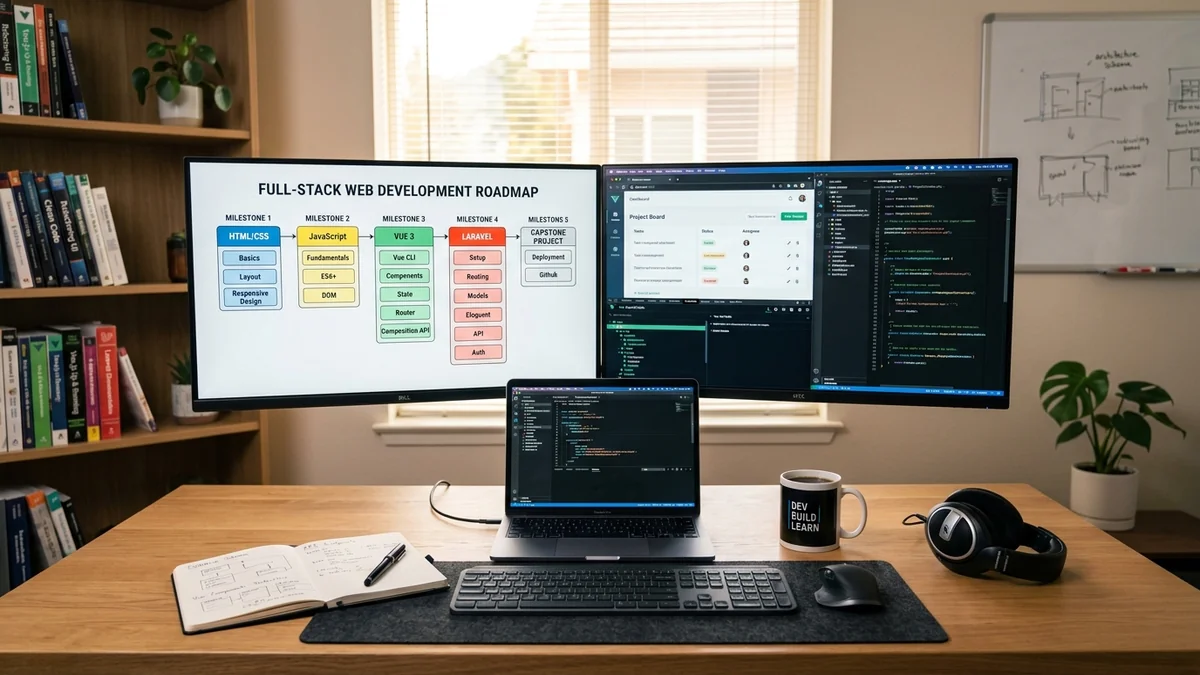
Web Development Curriculum: Full
Master full-stack web development. Comprehensive curriculum covering HTML/CSS/Tailwind, ES6+ JavaScript, Vue 3 & Vite, Laravel APIs, and CI/CD deployment.

Web Application Performance Optimization
Boost backend and frontend speed with actionable web application performance optimization tactics. Eliminate N+1 queries, memory leaks, and CPU cache misses.