
Software Architecture Principles

Designing scalable software requires structured methodologies beyond raw coding. Mastering Software Architecture Principles connects strategic planning (Wardley Mapping, Impact Mapping), domain modeling (Event Storming, Bounded Contexts), decision documentation (ADRs, MADRs), and hierarchical system visualization (C4 Model, arc42).
Table of Contents
- The Architect's Responsibility in Modern Engineering
- 4 Core Pillars of Software Architecture Principles
- Visualizing the Architectural Decision & Design Lifecycle
- 29 Fundamental Architecture Techniques Breakdown
- Frequently Asked Questions
- Conclusion & Next Steps
- Sources & Image Attributions
The Architect's Responsibility in Modern Engineering
Building enterprise-grade digital systems is rarely constrained by programming language features. The primary causes of project failure are ambiguous domain boundaries, unrecorded technical decisions, untracked technical debt, and architectural drift.
Applying rigorous Software Architecture Principles equips software architects and lead engineers with shared models, structured decision records, and visual communication frameworks to guide cross-functional teams.
Pairing architecture techniques with API design standards from TypeScript SaaS Architecture and enterprise SEO frameworks from Enterprise SEO Strategies establishes solid system foundations.
4 Core Pillars of Software Architecture Principles
The 29 fundamental architectural techniques span four core phases:
1. Strategic Alignment & Domain Discovery
Methods like Event Storming, Domain Storytelling, and Impact Mapping that align software boundaries with real-world business domains and ubiquitous language.
2. Decision Governance & Technical Debt Management
Lightweight documentation formats like Architecture Decision Records (ADRs) and Technical Debt Records (TDRs) that preserve architectural context over time.
3. Hierarchical Visualization & Docs-as-Code
Visual notation models like the C4 Model and the arc42 framework that communicate architecture from high-level context down to component code.
4. Continuous Evaluation & DORA Metrics
Measurement frameworks like DORA metrics and LASR reviews that assess deployment frequency, change failure rates, and system resilience.

Visualizing the Architectural Decision & Design Lifecycle
How architecture techniques guide software from discovery to continuous improvement:
flowchart TD
    A["Business Domain Discovery: Event Storming & Ubiquitous Language"] --> B["System Boundary Modeling: Bounded Context Canvas"]
    B --> C["Architectural Decision Formulation: ADR / MADR"]
    C --> D["Hierarchical Visualization: C4 Model (Context to Code)"]
    D --> E["Implementation & CI/CD Delivery"]
E --> F["Evaluation & Performance Tracking: DORA Metrics"]Commit ADRs directly to your Git repository (docs/adr/0001-use-postgresql.md). Storing architectural decisions in version-controlled markdown ensures that future engineers understand why specific trade-offs were made.
29 Fundamental Architecture Techniques Breakdown
🧭 Strategic Planning & Domain Modeling
- Impact Mapping: Connect business objectives to technical deliverables.
- Wardley Mapping: Map value chain evolution from genesis to commodity.
- Domain Storytelling: Use visual narratives to document business workflows.
- Event Storming: Workshop domain events, commands, and aggregates with domain experts.
- Ubiquitous Language: Establish shared terminology across business and tech teams.
- Bounded Context Canvas: Define service boundaries and team ownership.
- Context Mapping: Diagram relationships and contract upstream/downstream flows.
- Event Modeling: Blueprint time-ordered state changes and projection views.
✍️ Decision Making & Risk Governance
- Architecture Decision Records (ADR): Structured documents tracking architectural choices.
- Markdown ADR (MADR): Standardized, lightweight markdown template for ADRs.
- Technical Debt Records (TDR): Quantify and prioritize refactoring backlogs.
- Threat Modeling (STRIDE): Systematically identify security vulnerabilities.
- Risk Storming: Identify and mitigate quality attribute risks collaboratively.
🏛️ Visualization, Metrics & Documentation
- C4 Model: Hierarchical visualization (Context, Containers, Components, Code).
- arc42 Template: Comprehensive framework for system documentation.
- Documentation as Code: Version-controlled markdown documentation built via CI/CD.
- Technology Radar: Manage tool adoption stages (Adopt, Trial, Assess, Hold).
- DORA Metrics: Track deployment velocity and system stability.
- Residuality Theory: Architect systems to absorb unexpected stressors.
Frequently Asked Questions
What are the four levels of the C4 model?
The C4 model consists of Context (Level 1: System users and external systems), Containers (Level 2: Applications, databases, microservices), Components (Level 3: Internal modules), and Code (Level 4: Class/entity diagrams).
When should a team start writing ADRs?
From day one of a project. Any decision that impacts persistence layers, authentication frameworks, API protocols, or architectural patterns warrants a recorded ADR.
What is the primary difference between Event Storming and Event Modeling?
Event Storming is an exploratory, open-ended workshop for domain discovery, whereas Event Modeling is a structured blueprinting technique for designing exact UI commands, events, and read models over time.
Conclusion & Next Steps
Adopting these Software Architecture Principles enables engineering leaders to design resilient systems, align technical roadmaps with business goals, and avoid costly architectural rewrites.
At Masri Systems, we architect high-performance digital platforms, developer workflow systems, and scalable software applications. Explore our specialized Software Development and Website Architecture services to build scalable digital systems for modern enterprises.
Sources & Image Attributions
- Header Image: Developer working on code review by Caspar Camille Rubin on Unsplash
- Body Image: Team collaborating on software architecture by Annie Spratt on Unsplash
Follow Masri Systems on Google
Add us as a preferred source in Google Search.
Related Articles & Guides

Free Developer Certifications: 5 High-Impact Courses & Badges
5 verifiable free developer certifications and coding courses from Postman, Google Cloud, DeepLearning.AI, and freeCodeCamp to elevate your engineering resume.

Geschäftsprozesse automatisieren: 17 Scheduled Tasks der Agentur
Wie Masri Systems 17 autonome Agenten-Jobs, Sidecars und Cron-Tasks einsetzt, um Geschäftsprozesse im Entwickler-Alltag wartungsfrei zu automatisieren.

Sectors of Computer Science & Software Engineering
Explore the primary disciplines of computer science, tech career paths, software engineering specialization tracks, and modern developer tooling.

Software Engineer Career Roadmap
Explore the complete software engineer career roadmap. Master junior to senior transitions, high-demand tech specializations, and modern AI development.

Why PHP 8.4 & Laravel Are the Smartest Choice for Web Apps
Explore modern PHP web development. Discover why PHP 8.4 performance, strict typing, JIT compilation, and Laravel make PHP the top choice for software teams.
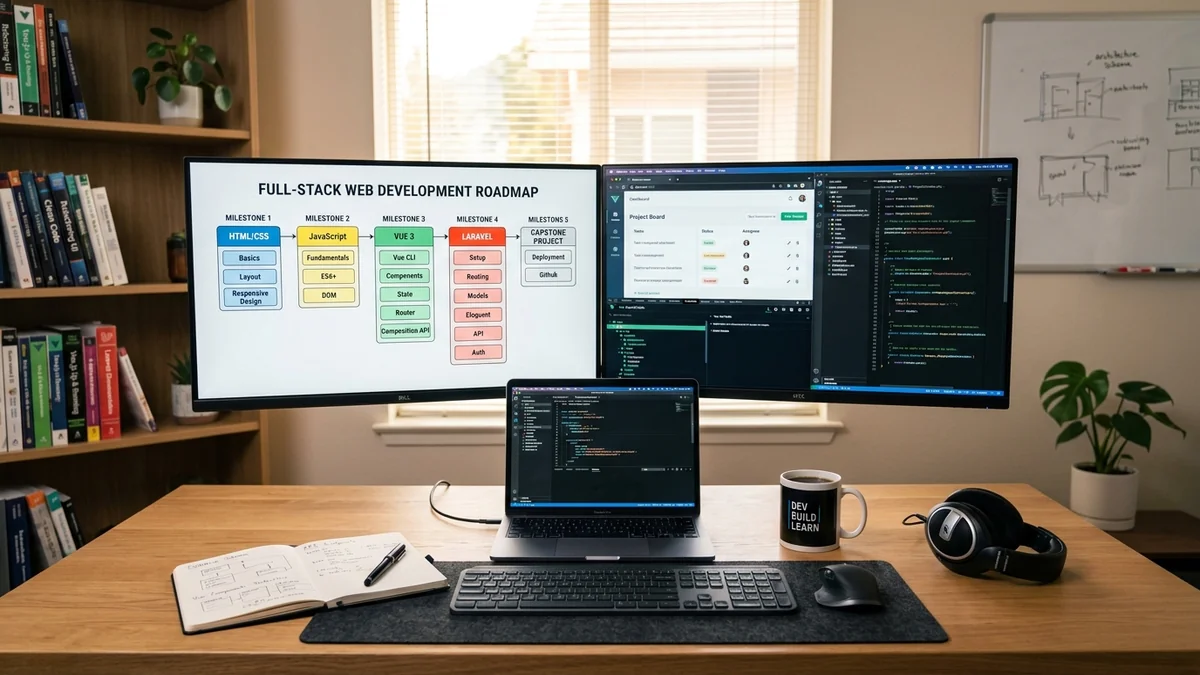
Web Development Curriculum: Full
Master full-stack web development. Comprehensive curriculum covering HTML/CSS/Tailwind, ES6+ JavaScript, Vue 3 & Vite, Laravel APIs, and CI/CD deployment.

Was ist eine Homepage Erklärung
Was ist eine Homepage Erklärung: Erfahren Sie den entscheidenden Unterschied zur Website, die 3 Kernaufgaben einer Startseite und den perfekten Seitenaufbau.

Vue JS Application Architecture
Master Vue JS application architecture. Comprehensive scaffolding guide covering TypeScript interfaces, modular directory structure, Pinia, and VueUse.